Wednesday, April 12, 2017

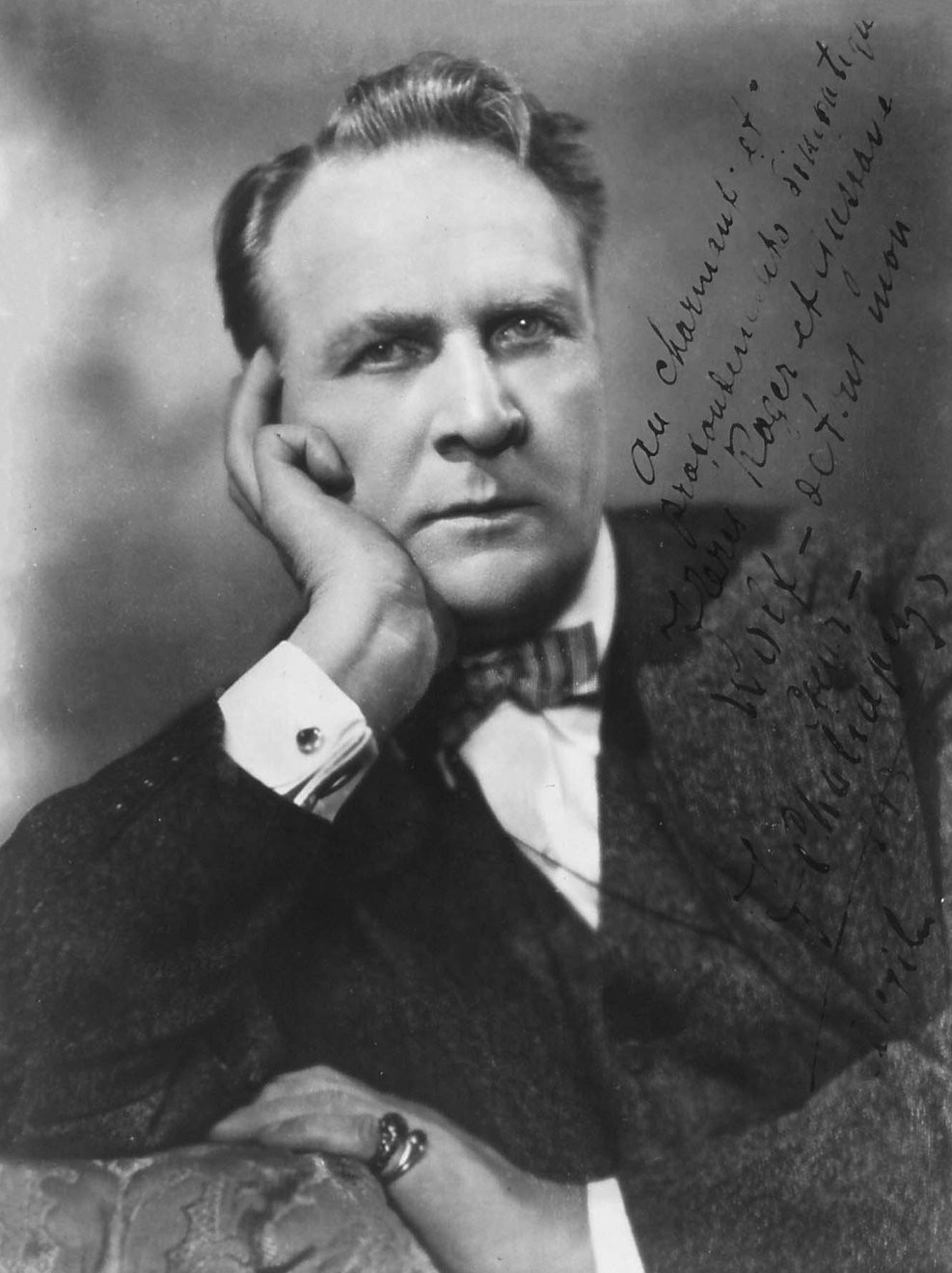
Fedor Chalipin, most famous Russian basso singer, died today in 1938 in Paris

Fédor Chaliapine (Фёдор Иванович Шаляпин) est un chanteur russe d'opéra, né le 13 février 1873 à Kazan et mort le 12 avril 1938 à Paris, est un chanteur d'opéra (basse) et acteur russe. Sa carrière internationale débute en 1901 à la Scala de Milan, puis au Metropolitan Opera de New York en 1907.
En 1922 il émigre à Paris.


Feodor Ivanovich Chaliapin (Фёдор Иванович Шаляпин) was a Russian opera singer, born 13 Feb 1873 in Kazan. Possessing a deep and expressive bass voice, he enjoyed an important international career at major opera houses and is often credited with establishing the tradition of naturalistic acting in his chosen art form. He did not return to Russia after 1921. He initially moved to Finland and later lived in France. Cosmopolitan Paris, with its significant Russian émigré population, became his base, and ultimately, the city of his death on 12 April 1938. He was renowned for his larger-than-life carousing during this period, but he never sacrificed his dedication to his art. Chaliapin's attachment to Paris did not prevent him from pursuing an international operatic and concert career in England, the United States, and further afield.
Fédor Chaliapine
Fédor Chaliapine
Plaque: 22, avenue d'Eylau

Feodor Chaliapine
artiste lyrique russe
1873-1938
vécut et mourut
dans cette maison.

Feodor Ivanovich Chaliapin,
Russian opera singer,
1873-1938,
lived and died
in this house.

Wikipédia fr:Fédor Chaliapine
Wikipedia En:Feodor Chaliapin
Copyrights: Images hotlinked from Wikipedia Commons retain their licences. All other pictures are CC-BY-NC-SA, Serendiparis, 2001-2013

Tuesday, April 11, 2017

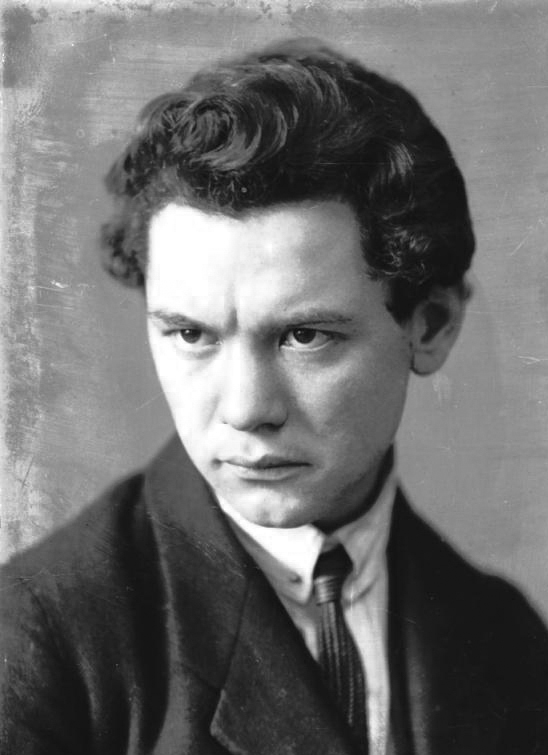
Attila József, Hungarian poet, was born today in 1905.

Attila József (ou József Attila dans l’ordre usuel en hongrois), poète de la révolte, à étudié à la Sorbonne en 1926-1927. Il était né le 11 avril 1905 à Budapest et est mort le 3 décembre 1937 à Balatonszárszó au bord du lac Balaton.


Attila József, Hungarian poet, was born 11 April 1905 in Budapest. With the help of a patron, he acquired a good education in Hungary, Austria (1925) and Paris (1926–27), where he studied French literature and discovered the work of François Villon. He died 3 December 1937 in Balatonszárszó.
Attila Jozsef
Attila Jozsef
Plaque: 6, rue du Vieux Colombier
Dans cette maison
vécut en 1926 le
poète hongrois
Attila Jozsef
(1905-1937)

In this house
lived in 1926
the Hungarian poet
Attila Jozsef
(1905-1937)

Wikipédia fr:Attila József
Wikipedia En:Attila József
Copyrights: Images hotlinked from Wikipedia Commons retain their licences. All other pictures are CC-BY-NC-SA, Serendiparis, 2001-2013

Sunday, May 22, 2016

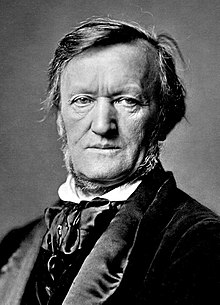
Richard Wagner, German composer, was born today in 1813

Wilhelm Richard Wagner (né le 22 mai 1813, Leipzig - mort le 13 février 1883, Venise) est un compositeur allemand, qui fit à Paris plusieurs séjours, comméorés par trois plaques.

Wagner doit son importance dans l'histoire de la musique occidentale à ses opéras, en particulier L'Anneau du Nibelung, festival scénique en un prologue et trois journées dont il a écrit lui-même les poèmes et dont la conception bouscule délibérément les habitudes de l'époque pour aller, selon ses propres termes, vers un « art total » : spectacle complet, mélodie continue et emploi du leitmotiv.
Richard Wagner (22 May 1813 – 13 February 1883) was a German composer, conductor, and theatre director, who made several stays in Paris, as three plaques remind the passer-by.

He is  primarily known for his operas (or "music dramas", as he later called them). Wagner's compositions, particularly those of his later period, are notable for their complex texture, rich harmonies and orchestration, and the elaborate use of leitmotifs: musical themes associated with individual characters, places, ideas or plot elements.
Richard Wagner
Richard Wagner
Plaque: 3, rue d'Aumale
Richard Wagner,
1813-1883,
vécut dans cet immeuble
d'octobre 1860
à
juillet 1861.

Les Cercles Wagner de France
Richard Wagner,
1813-1883,
lived here
from October 1860
to
July 1861.

Les Cercles Wagner de France
Plaque: 19, quai Voltaire
Ici
Charles Baudelaire
Jean Sibelius
Richard Wagner
Oscar Wilde
ont honoré Paris
de leur séjour
Charles Baudelaire
Jean Sibelius
Richard Wagner
Oscar Wilde
stayed here while in Paris
Plaque: 14, rue Jacob
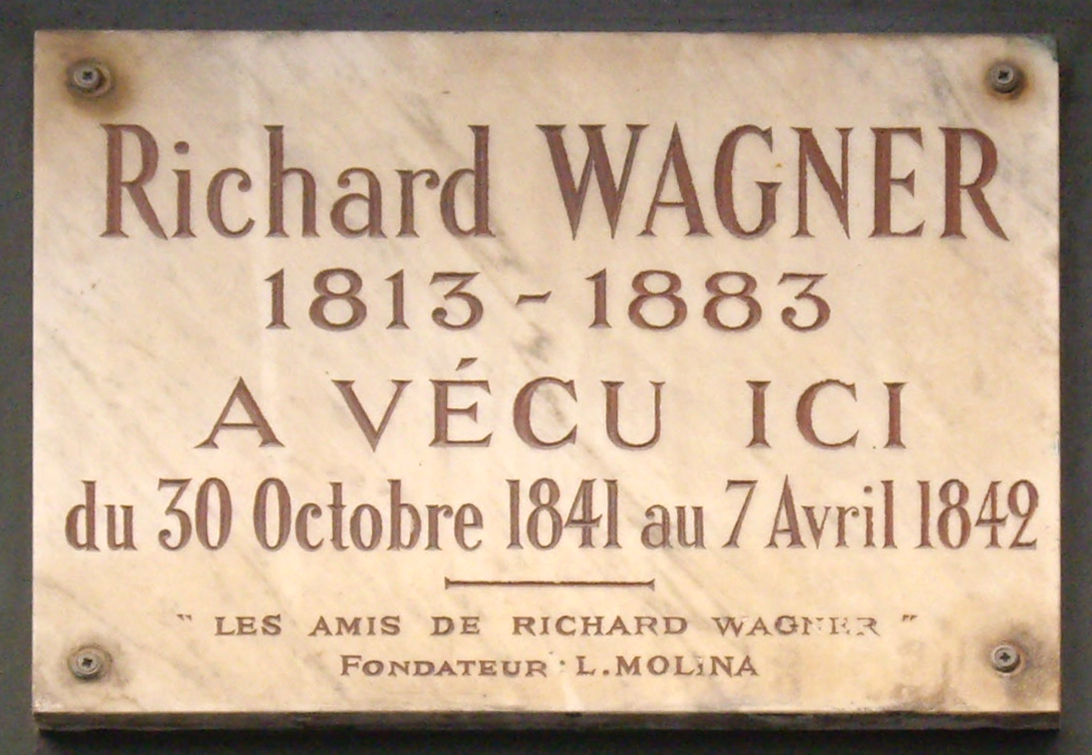
Richard Wagner, 1813-1883, a vécu ici du 30 octobre 1841 au 7 avril 1842. "Les amis de Richard Wagner", Fondation L.Molina
Richard Wagner, 1813-1883, lived here from 30 October 1841 through 7 April 1842. "The Friends of Richard Wagner", L.Molina foundation.
Plaque: 58, rue de Courcelles
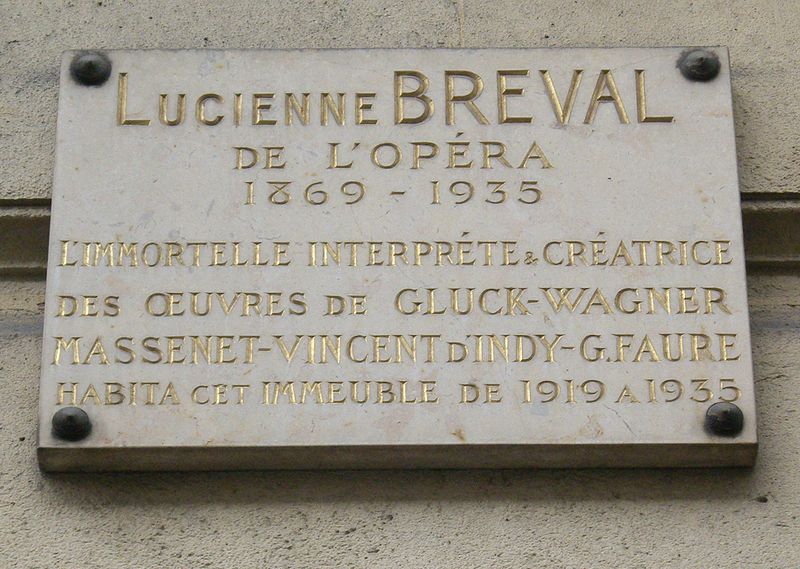
Lucienne Bréval, de l'Opéra, 1869-1935. L'immortelle interprète et créatrice des œuvres de Gluck, Wagner, Massenet, Vincent d'Indy, Gabriel Fauré, habita cet immeuble de 1919 à 1935.
Opera singer Lucienne Bréval, 1869-1935. The immortal interpreter et creator of works by Gluck, Wagner, Massenet, Vincent d'Indy, Gabriel Fauré, lived here , 1919 - 1935.

Wikipédia fr:Richard Wagner
Wikipedia En:Richard Wagner
Copyrights: Images hotlinked from Wikipedia Commons retain their licences. All other pictures are CC-BY-NC-SA, Serendiparis, 2001-2013
Thursday, May 19, 2016

Ho Chi Minh, Vietnam head of state, was born today in 1890

Ho Chí Minh, né le 19 mai 1890 à Hoàng Trù et mort le 2 septembre 1969 à Hanoï, est un homme d'État vietnamien, fondateur de la République démocratique du Viêt Nam.
Né Nguyên Sinh Cung, il est également connu sous les noms de Nguyên Aï Quoc ou «oncle Hô».
Ho Chí Minh is the founder of the Democraic Republic of Vietnam. Born Nguyên Sinh Cung on 19 May 1890, he is also known as Nguyên Aï Quoc. He lived in Paris for a number of years, from 1917 or 1919, and joined a group of Vietnamese nationalists there. He travelled extensively under various names, including several stays in Paris.    
Ho Chi Minh | Ho Chi Minh, the face on the VND 500,000 banknote.
Plaque: 9, impasse Compoint
Ici de 1921 à 1923 a vécu
et milité pour l'indépendance
et la liberté du peuple
vietnamien et des autres
peuples opprimés
Nguyên Ái Quoc,
connu sous le nom de
Ho Chí Minh.
Janvier 1983
 
Between 1921 and 1923 here lived and campaigned for the freedom of the Vietnamese people of other oppressed peoples
Nguyên Ái Quoc,
known as
Ho Chí Minh.
January 1983

Wikipédia fr:Ho Chi Minh
Wikipedia En:Ho Chi Minh
Copyrights: Images hotlinked from Wikipedia Commons retain their licences. All other pictures are CC-BY-NC-SA, Serendiparis, 2001-2013

Friday, May 13, 2016

The Society of The Cincinnati was founded today in 1783 by George Washington

La Société des Cincinnati (Society of the Cincinnati) est la plus ancienne société patriotique américaine, fondée par George Washington le 13 mai 1783 et composée de ceux qui s'étaient distingués pendant la Guerre d'indépendance des États-Unis.
La section française a été fondée en janvier 1784 à Paris.


The Society of the Cincinnati was founded by George Washingtion to preserve the ideals and fellowship of the American Revolutionary War officers. Its French branch was founded in January 1784 in Paris, to which a plaque near the Latin Quarter bears testimony.

   
Société des Cincinnati
Plaque: 40, rue du Cherche Midi
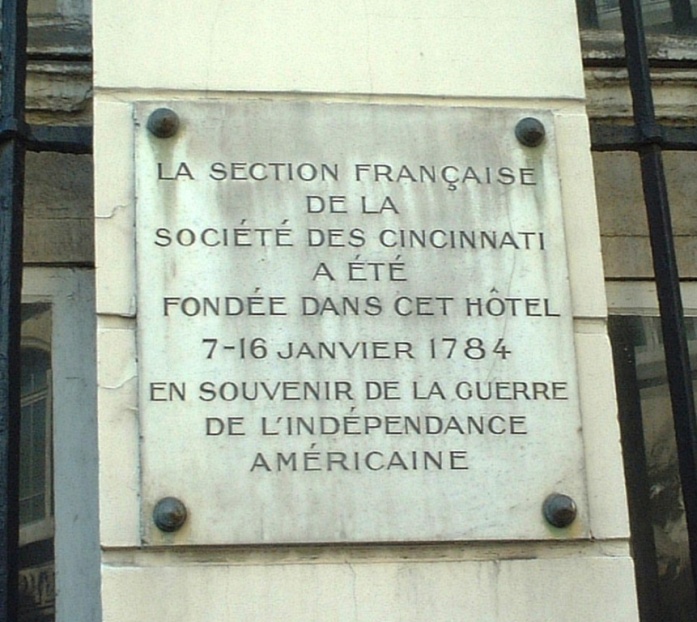
La section francaise
de la
société des Cincinnati
a été
fondée dans cet hôtel
7-16 janvier 1784
en souvenir de la guerre
de l'indépendance
américaine

The French branch of the Society of the Cincinnati was founded in this mansion, 7-16 January 1784, in remembrance of the American Independance War  

Wikipédia fr:Société des Cincinnati
Wikipedia En:Society of the Cincinnati
Copyrights: Images hotlinked from Wikipedia Commons retain their licences. All other pictures are CC-BY-NC-SA, Serendiparis, 2001-2013

Saturday, April 16, 2016

Tristan Tzara, poet and founder of Data, was born today in 1986

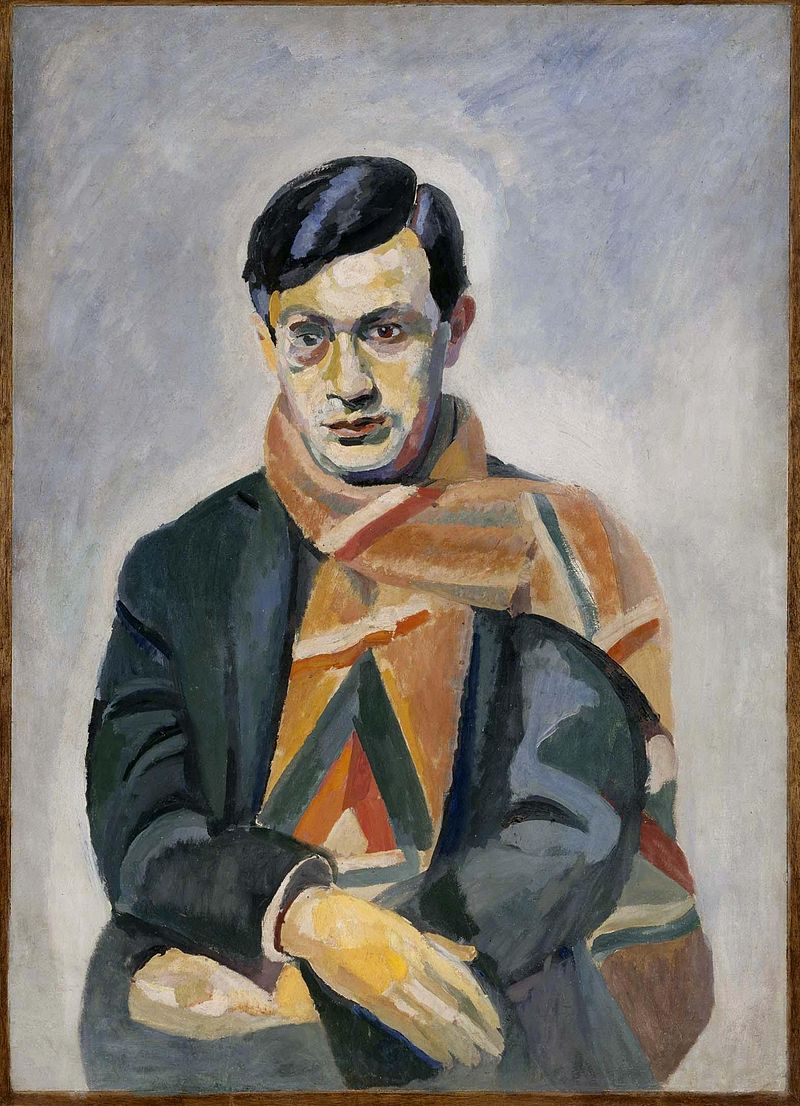
Tristan Tzara, né le 16 avril 1896 à Moinesti, Roumanie et mort le 25 décembre 1963 à Paris, est un écrivain, poète et essayiste de langue roumaine et française; il est l'un des fondateurs du mouvement Dada dont il sera par la suite le chef de file.

Tristan Tzara, a Romanian and French avant-garde poet, essayist and performance artist, one of the founders and central figures of the anti-establishment Dada movement, was born in Romania in 1896, moved to Paris in 1911, where he spent most of his life. He died in Paris on Christmas day, 1963. His house in Montmartre was designed by Austrian architect Adolf Loos.     
Tristan Tzara
Tristan Tzara
by Robert Delaunay
Plaque: 29, rue Campagne Première
Dans l'effervescence créatrice des années 1920 L'hôtel Istria accueillit entre autres artistes Francis Picabia, Marcel Duchamp, Moïse Kisling, peintres; Man Ray, photographe; Kiki de Montparnasse, modèle et égérie; Eric Satie, compositeur; Rainer-Maria Rilke, Tristan Tzara, Vladimir Maïakovski, poètes; et Louis Aragon qui y rejoignait Elsa Triolet.

"Ne s'éteint que ce qui brilla... Lorsque tu descendais de l'hôtel Istria Tout était différent rue Campagne Première, En mil neuf cent vingt neuf, vers l'heure de midi...", Louis Aragon (Il ne m'est Paris que d'Elsa).

Association La Mémoire des Lieux

In the roaring 1920s this hotel Istria hosted numerous artists including Francis Picabia, Marcel Duchamp, Moïse Kisling, painters; Man Ray, photographer; Kiki de Montparnasse, model and égérie; Eric Satie, composer; Rainer-Maria Rilke, Tristan Tzara, Vladimir Maïakovski, poets; and Louis Aragon who joined Elsa Triolet.

"Only what has been bright can fade away… When you used to come to hôtel Istria every thing looked different in street Campagne Première, in nineteen hundred and twenty nine, around noon time…", Louis Aragon (Il ne m'est Paris que d'Elsa).

The Memory of Places Society
Plaque: 13, avenue Junot
Maison construite en 1926 par
l'architecte autrichien
Adolf Loos
1870 - 1933
pour l'écrivain Tristan Tzara

House built in 1926 by Austrian architect Adolf Loos (1870-1933) on behalf of writer Tristan Tzara.

Wikipédia fr:Tristan Tzara
Wikipedia En:Tristan Tzara
Copyrights: Images hotlinked from Wikipedia Commons retain their licences. All other pictures are CC-BY-NC-SA, Serendiparis, 2001-2013
Saturday, January 9, 2016

Simone de Beauvoir was born today in 1908

Simone de Beauvoir, née le 9 janvier 1908 dans le 6e arrondissement de Paris, ville où elle est morte le 14 avril 1986, philosophe, romancière, épistolière, mémorialiste et essayiste française souvent considérée comme une théoricienne importante du féminisme, a participé au mouvement de libération des femmes dans les années 1970. Elle a partagé la vie du philosophe Jean-Paul Sartre.
 

Simone de Beauvoir (9 January 1908 – 14 April 1986) was a French writer, intellectual, existentialist philosopher, political activist, feminist and social theorist. She had a significant influence on both feminist existentialism and feminist theory. De Beauvoir wrote novels, essays, biographies, autobiography and monographs on philosophy, politics and social issues. She is known for her 1949 treatise The Second Sex, a detailed analysis of women's oppression and a foundational tract of contemporary feminism; and for her novels, including She Came to Stay and The Mandarins. She is also known for her open relationship with French philosopher Jean-Paul Sartre.
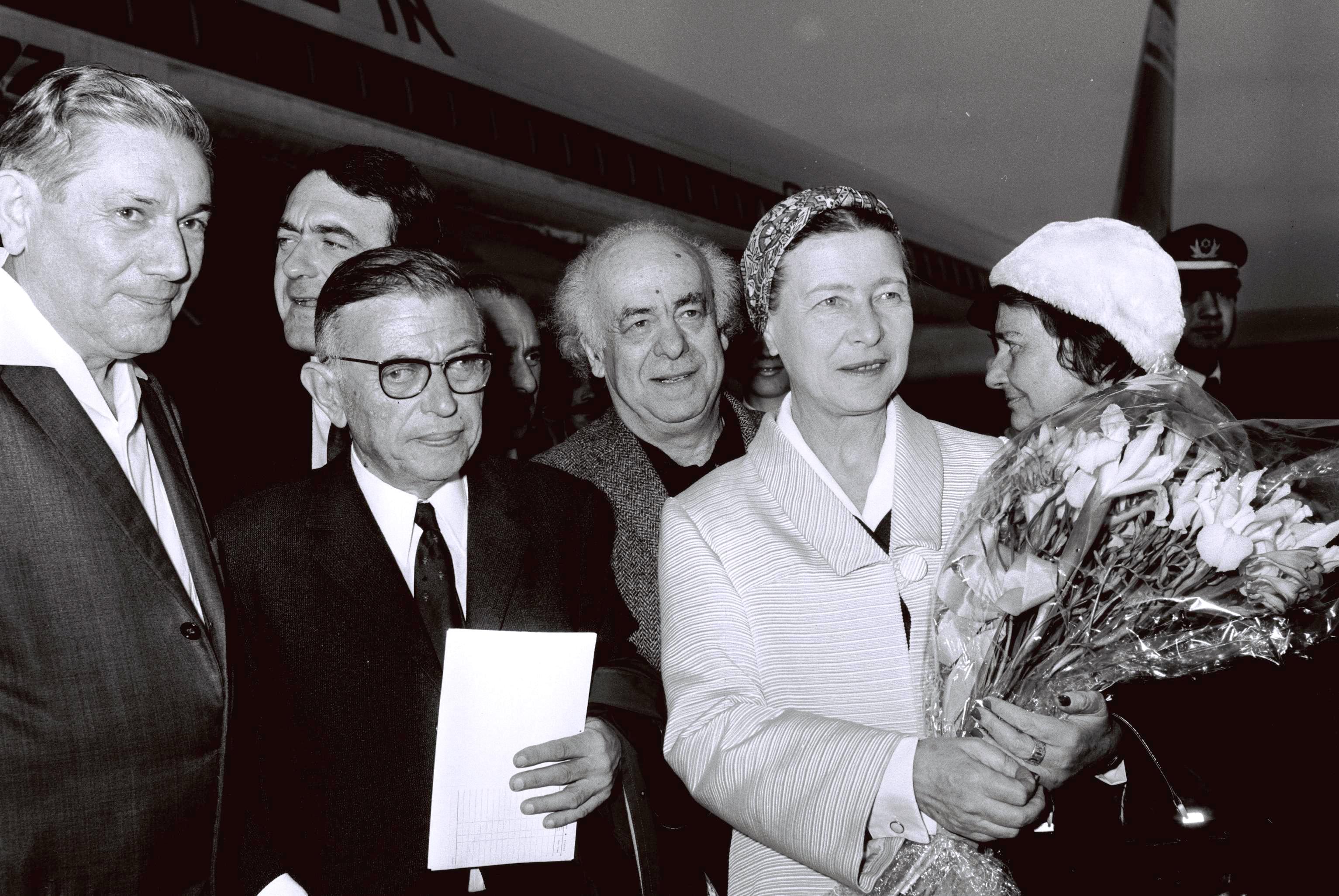
Simone de Beauvoir | Beauvoir and Sartre arriving Israel, welcomed by Avraham Shlonsky and Leah Goldberg, 1967
Plaque: 24, rue Cels
Dans cet hôtel ont habité, entre 1937 et 1939 puis à diverses reprises durant la guerre, Simone de Beauvoir (1908-1986), Jean-Paul Sartre (1905-1980). "Je trichais quand je disais: on ne fait qu'un. Entre deux individus, l'harmonie n'est jamais donnée, elle doit indéfiniment se conquérir." (S. de Beauvoir, La Force de l'âge) "Mais il est une chose qui ne change point, ni ne peut changer: c'est que quoi qu'il arrive et quoi que je devienne, je le deviendrai avec vous." (J.P. Sartre, Lettres au Castor). Soucieux de préserver leur liberté mutuelle, ils occupaient à l'hôtel deux chambres séparées dominant le cimetière du Montparnasse, où la mort les a réunis. Association La Mémoire des lieux.
Simone de Beauvoir (1908-1986) and Jean-Paul Sartre (1905-1980) stayed in this hotel in 1937-1939 and then again during WWII. "I was lying when I was saying: We are one. Between two individuals harmony is never given, it must be conquered endlessly.'(S. de Beauvoir, La Force de l'âge / The Prime of Life). "But one thing will never and cannot change: whatever happens, and whoever I become I will become it with you' (J.P. Sartre, Lettres au Castor / Witness to My Life & Quiet Moments in a War). Anxious to preserve their personal liberty, they stayed in two rooms, each with a view to the Montparnasse cemetery, where they are re-united.  Association La Mémoire des lieux.
Plaque: 11bis, rue Victor Schoelcher
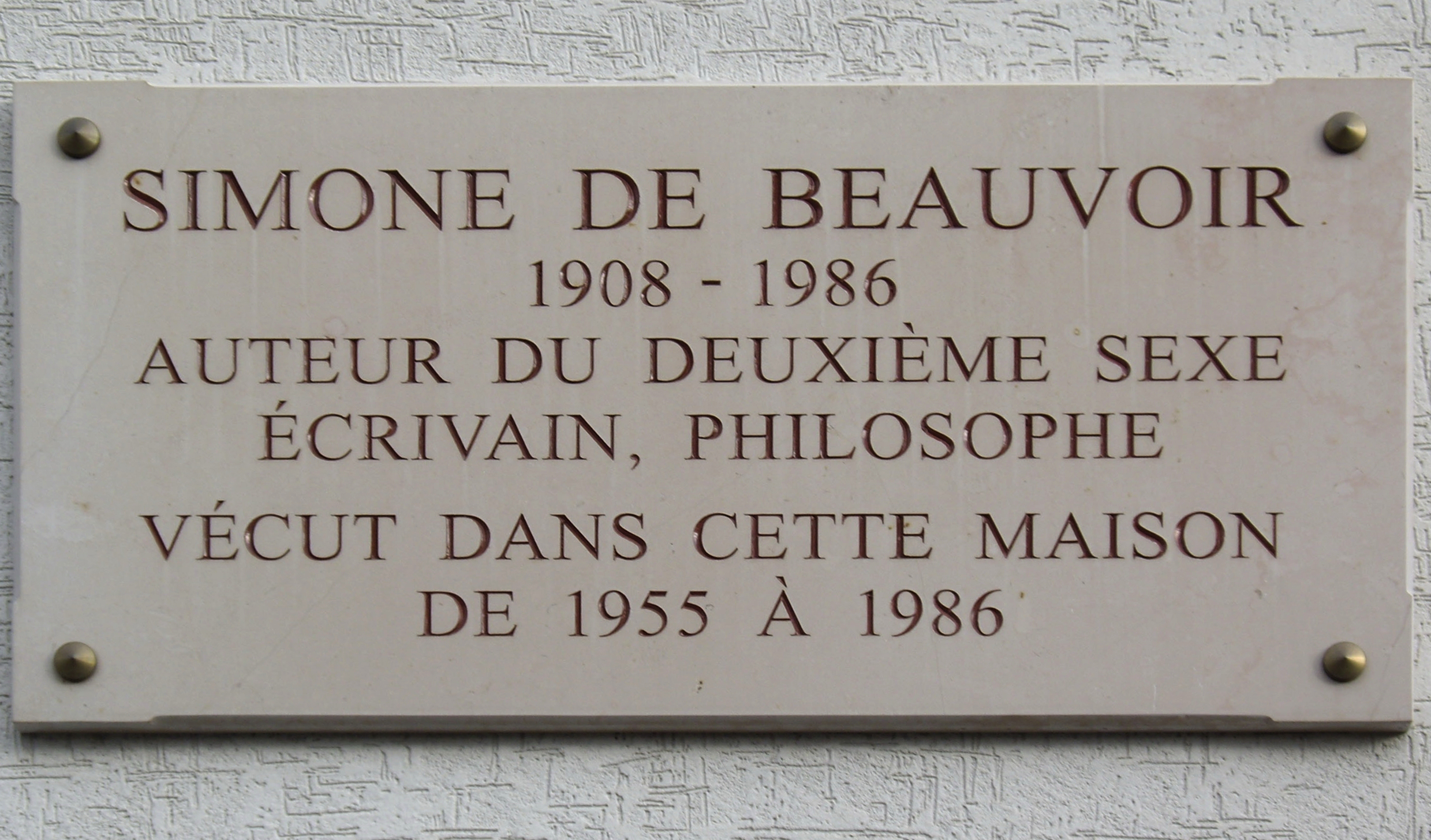
Simone de Beauvoir, 1908-1986, auteur du Deuxième sexe, écrivain, philosophe, vécut dans cette maison de 1955 à 1986
Simone de Beauvoir, 1908-1986, writer and philosopher who authored The Second Sex, lived in this house 1955 - 1986.

Wikipédia fr:Simone de Beauvoir
Wikipedia En:Simone de Beauvoir
Copyrights: Images hotlinked from Wikipedia Commons retain their licences. All other pictures are CC-BY-NC-SA, Serendiparis, 2001-2013
Friday, January 8, 2016

Winnaretta Singer, princesse de Polignac, was born today in 1865

Winnaretta Singer, princesse Edmond de Polignac, dite « Winnie » née à Yonkers (État de New York) le 8 janvier 1865 et morte à Londres le 26 novembre 1943, est une mécène musicale, et l'héritière des machines à coudre Singer.
 
La Fondation Singer-Polignac, créée en 1928, se consacre à des activités de mécénat en faveur des arts, des lettres et des sciences et œuvre grâce à ses propres fonds.

Winnaretta Singer, Princesse Edmond de Polignac (Yonkers, NY, 8 January 1865 – London, UK, 26 November 1943) was an American musical patron and heir to the Singer sewing machine fortune.
Her mother, Parisian-born Isabella Boyer, was possibly the model for Bartholdi's Statue of Liberty. After the outbreak of American Civil War, the Singer family moved to Paris, where they remained until the Franco-Prussian War.
In 1894 the Prince and Princesse de Polignac established a salon in Paris in the music room of their mansion on Avenue Henri-Martin (today, Avenue Georges-Mandel). The Polignac salon came to be known as a haven for avant-garde music. First performances of Chabrier, d'Indy, Debussy, Fauré, and Ravel took place in the Polignac salon. The young Ravel dedicated his piano work, Pavane pour une infante défunte, to the Princesse de Polignac. Many of Marcel Proust's evocations of salon culture were born during his attendance at concerts in the Polignac drawing room.
Winnaretta Singer | Harris & Ewing Collection (Library of Congress).
Plaque: 43 Avenue Georges-Mandel
Fondation Singer-Polignac, créée le 25 mars 1928, par la princesse Edmond de Polignac, née Winnaretta Singer. 1865-1943
Singer-Polignac Foundation, created 25 March 1928, by the princess Edmond de Polignac, née Winnaretta Singer. 1865-1943

Wikipédia fr:Winnaretta Singer
Wikipedia En:Winnaretta Singer
Copyrights: Images hotlinked from Wikipedia Commons retain their licences. All other pictures are CC-BY-NC-SA, Serendiparis, 2001-2013

Wednesday, January 6, 2016

Khalil Gibran, Lebanese American writer, was born today in 1883

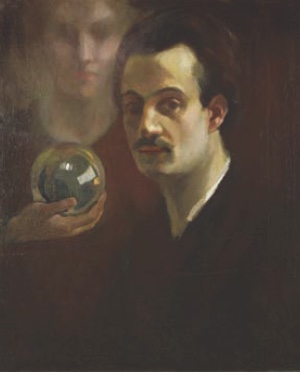
Gibran Khalil Gibran (جبران خليل جبران), poète et peintre libanais, est né le 6 janvier 1883 à Bcharré, Liban. En 1895, il émigre avec sa famille aux États-Unis, où il vivra la majeure partie de sa vie; il est mort le 10 avril 1931 à New York. En 1908-1910, Gibran étudier la peinture à Paris, où il fréquente, entre autres, l'atelier Colarossi. Publié en 1923 et composé de vingt-six textes poétiques, son recueil "Le Prophète" est devenu particulièrement populaire pendant les années 1960 dans le courant de la contre-culture et les mouvements New Age.
 

Kahlil Gibran (جبران خليل جبران)(January 6, 1883 – April 10, 1931), a Lebanese-American artist, poet, and writer, was born in the north of modern-day Lebanon, and immigrated with his family to the United States in 1895, where he studied art and began his literary career, writing in both English and Arabic. He studied painting in Paris in 1908-1910. He is chiefly known in the English-speaking world for his 1923 book The Prophet, an early example of inspirational fiction including a series of philosophical essays written in poetic English prose, which gained popularity in the 1960s counterculture.
Khalil Gibran | selfportrait/autoportrait, c. 1911
Khalil Gibran | autoportrait, c. 1911
Plaque: 14, avenue du Maine
Ici
vécut
de 1908 à 1910
Gibran Khalil Gibran
1883-1931
peintre et poète
libano-americain.
Gibran Khalil Gibran
1883-1931
Lebanese American
painter and poet
lived
here
1908 - 1910.

Wikipédia fr:Khalil Gibran
Wikipedia En:Khalil Gibran
Copyrights: Images hotlinked from Wikipedia Commons retain their licences. All other pictures are CC-BY-NC-SA, Serendiparis, 2001-2013

Monday, January 4, 2016

Louis Braille, benefactor to the blind, was born today in 1809

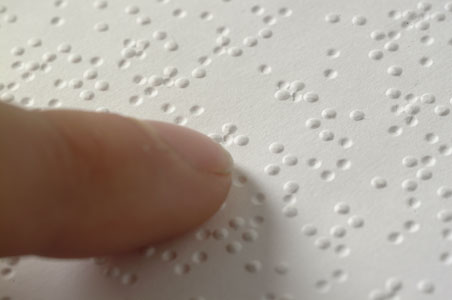
Louis Braille, né le 4 janvier 1809 à Coupvray, près de Paris, et mort le 6 janvier 1852, est l'inventeur du système d'écriture tactile à points saillants, à l'usage des personnes aveugles ou fortement malvoyantes : le braille.
Louis Braille (4 January 1809 – 6 January 1852) was a French educator and inventor of a system of reading and writing for use by the blind or visually impaired. His system remains known worldwide simply as braille.
Louis Braille | Braille close-up
Plaque: 2, rue des Écoles
Louis Braille
1809-1852
L'inventeur du braille a conçu son
système universel à cet emplacement,
lorsque l'institut des jeunes aveugles
s'y trouvait de 1816 à 1843.
INJA 2002
Louis Braille
1809-1852
The Braille system's inventor designed it here,
where the institut des jeunes aveugles (Institute for Blind Youth) stood between 1816 and 1843.
INJA 2002

Wikipédia fr:Louis Braille
Wikipedia En:Louis Braille
Copyrights: Images hotlinked from Wikipedia Commons retain their licences. All other pictures are CC-BY-NC-SA, Serendiparis, 2001-2013

Sunday, December 13, 2015

Heinrich Heine, born today in 1797, lived and died in Paris

Heinrich Heine, né le 13 décembre 1797 à Düsseldorf et mort le 17 février 1856 à Paris, est un poète et journaliste allemand.
Heirich Heine, German poet, was born in Dusseldorf, 13 Dec 1797. A plaque located at 3, Ave Matignon, indicates where he died  on 17 Feb 1856. Another plaque shows where he lived for nearly 5 years.
Heinrich Heine | 1831, Kunsthalle Hamburg
Heinrich Heine | Heinrich Heine, 1831, Kunsthalle Hamburg
Plaque: 3, avenue Matignon
Le poète
Henri Heine
né à Dusseldorf en 1797
est mort ici le 17.2.1856
The poet Henri Heine, born in Dusseldorf in 1797, died here on 17 February 1856
Plaque: 72, rue du Faubourg Poissonnière
Henri Heine
né à Dusseldorf le
13 décembre 1797
mort à Paris le
17 février 1856
a vécu dans cette maison de
septembre 1841 à avril 1846.
 
"Si quelqu'un vous demande
comment je me porte ici, dites
alors 'Comme un poisson dans
l'eau' ou plutôt dites aux gens que,
lorsque dans la mer un poisson
demande à un autre comment il se
porte, de cernier répond:
'Comme Heine à Paris'."
Henrich Heine,
born in Dusseldorf on
13 December 1797,
died in Paris on
17 February 1856
lived in this house from
September 1841 through April 1846.
 
"If people ask you how I feel here, answer 'Like a fish in water' or, rather, tell them that, when a fish in sea asks another fish how it feels, the latter answers: "Like Heine in Paris'"

Wikipédia fr:Heinrich Heine
Wikipedia En:Heinrich Heine
Copyrights: Images hotlinked from Wikipedia Commons retain their licences. All other pictures are CC-BY-NC-SA, Serendiparis, 2001-2013
Saturday, September 12, 2015

Elsa Triolet, Russian-French writer, was born today in 1896, in Moscow

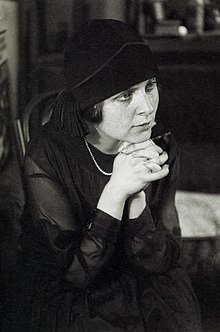
Elsa Triolet,  née Elsa Kagan, est une femme de lettres d'origine russe née le 12 septembre 1896 à Moscou. Après avoir, à19 ans, connu Maiakovski, elle épouse un offier français en 1918 et le suit à son retour en France. Elle rencontre Louis Aragon en 1928; leur vie commune dure jusqu'au décès d'Elsa, le 16 juin 1970, dans leur propriété de Saint-Arnoult-en-Yvelines. C'est Elsa qui incite Aragon à adhérer au parti communiste, et ils participent ensemble à la Résistance pendant la seconde guerre mondiale. Elsa Triolet est, en 1944, la première femme a obtenir le prix Goncourt.

Elsa Triolet,  née Elsa Kagan, is a French writer of Russian origin. She was born 12 September 1896 in Moscou. She meets Mayakovski, when she is 19. A year later, she marries a French army officer, and follows him when he returns to France, before divorcing. She meets Louis Aragon in 1928; they live together until she dies, 16 June 1970, in their property near Paris. It is Elsa who incites Aragon to join the Communist parti. They take part in the French Resistance. In 1944, she is the first woman to be awarded the prix Goncourt, the most famous prize in French literature.
Elsa Triolet | 1925
Elsa Triolet | 1925
Plaque: 29, rue Campagne Première
Dans l'effervescence créatrice des années 1920 L'hôtel Istria accueillit entre autres artistes Francis Picabia, Marcel Duchamp, Moïse Kisling, peintres; Man Ray, photographe; Kiki de Montparnasse, modèle et égérie; Eric Satie, compositeur; Rainer-Maria Rilke, Tristan Tzara, Vladimir Maïakovski, poètes; et Louis Aragon qui y rejoignait Elsa Triolet.

"Ne s'éteint que ce qui brilla... Lorsque tu descendais de l'hôtel Istria Tout était différent rue Campagne Première, En mil neuf cent vingt neuf, vers l'heure de midi...", Louis Aragon (Il ne m'est Paris que d'Elsa).

Association La Mémoire des Lieux
In the roaring 1920s this hotel Istria hosted numerous artists including Francis Picabia, Marcel Duchamp, Moïse Kisling, painters; Man Ray, photographer; Kiki de Montparnasse, model and égérie; Eric Satie, composer; Rainer-Maria Rilke, Tristan Tzara, Vladimir Maïakovski, poets; and Louis Aragon who joined Elsa Triolet.

"Only what has been bright can fade away… When you used to come to hôtel Istria every thing looked different in street Campagne Première, in nineteen hundred and twenty nine, around noon time…", Louis Aragon (Il ne m'est Paris que d'Elsa).

The Memory of Places Society

Wikipédia fr:Elsa Triolet
Wikipedia En:Elsa Triolet
Copyrights: Images hotlinked from Wikipedia Commons retain their licences. All other pictures are CC-BY-NC-SA, Serendiparis, 2001-2013
Friday, July 24, 2015

Alfons Mucha, Art Nouveau painter, was born today in 1860.

Alfons Maria Mucha (Alphonse Mucha), né à Ivancice (ville de Moravie qui faisait alors partie de l'Empire d'Autriche, aujourd'hui sise en République tchèque) le 24 juillet 1860 et mort à Prague le 14 juillet 1939, est un peintre tchèque, fer-de-lance du style Art nouveau.
Alfons Maria Mucha (24 July 1860 – 14 July 1939), known in English as Alphonse Mucha, was a Czech Art Nouveau painter and decorative artist, known best for his distinct style. He produced many paintings, illustrations, advertisements, postcards, and designs.
 
Mucha moved to Paris in 1887, and continued his studies at Académie Julian and Académie Colarossi. In addition to his studies, he worked at producing magazine and advertising illustrations. About Christmas 1894, Mucha happened to go into a print shop where there was a sudden and unexpected need for a new advertising poster for a play featuring Sarah Bernhardt, the most famous actress in Paris, at the Théâtre de la Renaissance on the Boulevard Saint-Martin. Mucha volunteered to produce a lithographed poster within two weeks, and on 1 January 1895, the advertisement for the play Gismonda by Victorien Sardou was posted in the city, where it attracted much attention. Bernhardt was so satisfied with the success of this first poster that she began a six-year contract with Mucha.
Alfons Mucha | Mucha, Autoportrait (BnF Gallica)
Plaque: 6, rue du Val de Grâce
Atelier Mucha
24.7.1860 Ivancice - 14.7.1939 Prague Praha
Le célèbre peintre tchèque représentant du style
Art Nouveau a vécu et travaillé dans cette maison
Znamy Cesky Secesni malir pusobil v tomto dome
1896 - 1903
Atelier Mucha
24.7.1860 Ivancice - 14.7.1939 Prague Praha
The famous Czech Art Nouveau painter used to live and work in this house, 1896-1903.
Plaque: 13, rue de la Grande Chaumière
Le peintre et graveur tchèque Alfons Mucha, 1860-1939, vécut dans cette maison de 1890 à 1893.  Il fut un des fondateurs de l'Art nouveau.
Czech painter and engraver Alfons Mucha, 1860-1939, lived in this house from 1890 to 1893. He was one of the fathers of Art Nouveau.

Wikipédia fr:Alfons Mucha
Wikipedia En:Alfons Mucha
Copyrights: Images hotlinked from Wikipedia Commons retain their licences. All other pictures are CC-BY-NC-SA, Serendiparis, 2001-2013

Saturday, July 18, 2015

Martin Flinker, Austrian writer and publisher, was born today in 1895

Martin Edward Flinker (né le 18 juillet 1895 à Czernowitz et mort le 21 juin 1986 à Paris) était un libraire, éditeur, auteur et critique littéraire autrichien.  Son nom est associé à des librairies célèbres, à Vienne et à Paris, celle de Paris ayant été un véritable microcosme de culture littéraire allemande.
Martin Edward Flinker (born 18 July 1895, Czernowitz - Died 21 June 1986, Paris) was an Austrian publisher, writer, bookseller and critique. He and his brother Karl managed two libraries, one in Vienna, one in Paris. The latter was renowned as microcosm of German literary culture.
Martin Flinker | Martin Flinker dans sa librairie - © Musée d'art et d'histoire du judaïsme
Martin Flinker dans sa librairie
© Musée d'art et d'histoire du judaïsme
Plaque: 48, quai des Orfèvres
Ici fut de 1948 à 1988 l'illustre librairie et maison d'édition de Martin et Karl Flinker dont les amis se nommaient Th. Mann, R. Musil, H. Hesse, H. Broch, S Zweig, P.Celan, Michaux, Éluard, Aragon, Queneau
Here was, from 1948 to 1988, the famous bookshop and publisher run by Martin and Karl Flinker, whose friends were Thomas Mann, Robert Musil, Hermann Broch, Stefan Zweig, Paul Celan, Herni Michaux, Paul Éluard, Louis Aragon, Raymond Queneau.

Wikipédia fr:Martin Flinker
Wikipedia En:
Copyrights: Images hotlinked from Wikipedia Commons retain their licences. All other pictures are CC-BY-NC-SA, Serendiparis, 2001-2013

Thursday, July 16, 2015

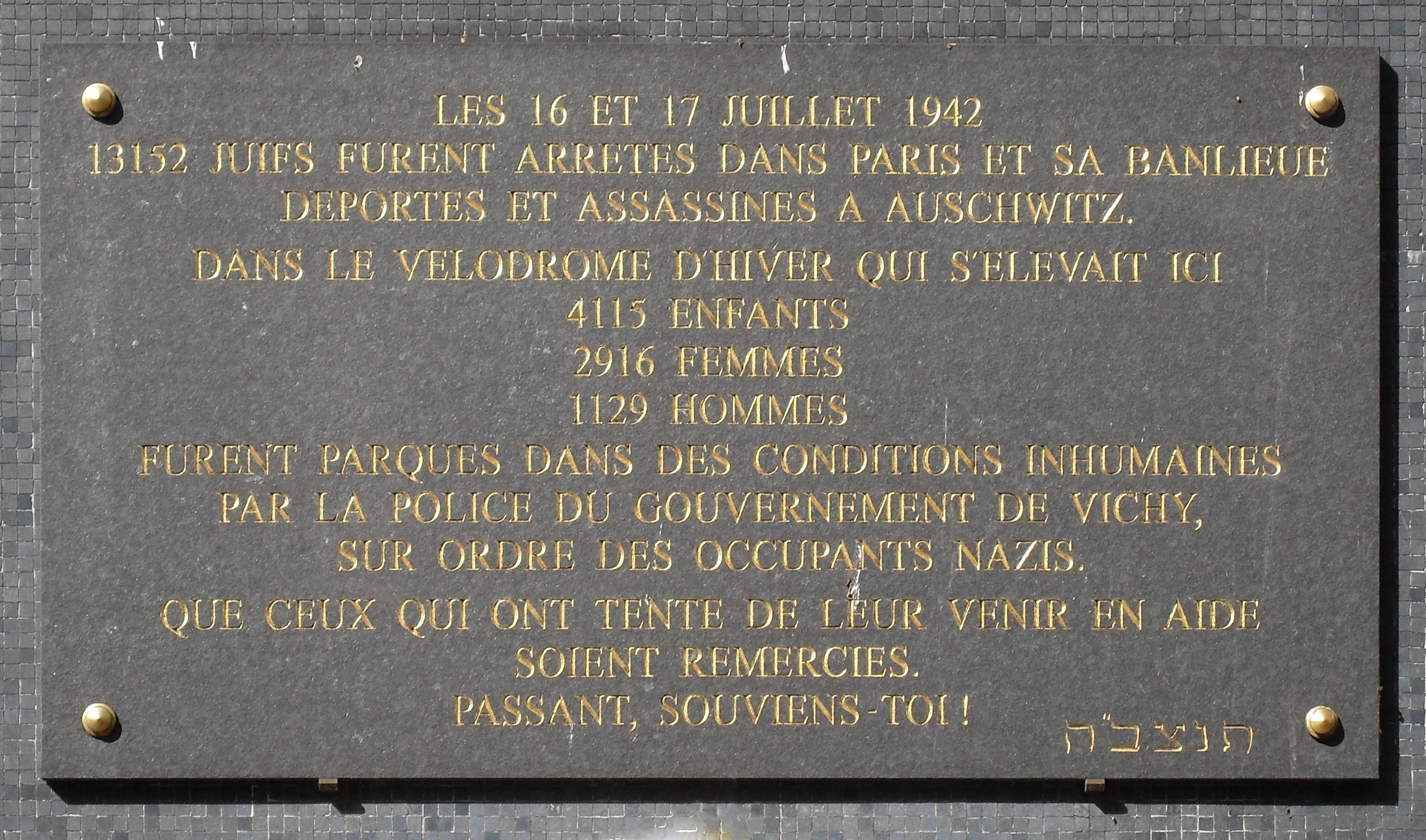
16-17 July 1942: Rafle du Vel d'Hiv, Thousands are arrested, to be later deported and murdered in Auschwitz

La rafle du Vélodrome d'Hiver (16-17 juillet 1942), souvent appelée rafle du Vel' d'Hiv, est la plus grande arrestation massive de Juifs réalisée en France pendant la Seconde Guerre mondiale. En juillet 1942, le régime nazi organise l'opération « Vent Printanier » : une rafle à grande échelle de Juifs dans plusieurs pays européens. En France, le régime de Vichy mobilise la police française pour participer à l'opération : à Paris, 9 000 policiers et gendarmes rafleront les Juifs. Le 17 juillet, en fin de journée, le nombre des arrestations dans Paris et la banlieue était de 13 152 selon les chiffres de la préfecture de police.
The Vel' d'Hiv Roundup (Rafle du vélodrome d'hiver), was a Nazi directed raid and mass arrest of Jews in Paris by the French police, on 16 and 17 July 1942. The roundup was one of several aimed at reducing the Jewish population in Occupied France. According to records of the Préfecture de Police, 13,152 victims were arrested, including more than 4,000 children. They were held at the Vélodrome d'Hiver (winter velodrome) in extremely crowded conditions, almost without water, food and sanitary facilities, as well as internment camps,then shipped by railway transports to Auschwitz for their mass murder. French President Jacques Chirac apologized in 1995 for the complicit role that French policemen and civil servants served in the raid.
Arrestations, juillet 1942
Plaque: 8, boulevard de Grenelle
Les 16 et 17 juillet 1942
13 152 juifs furent arrêtés dans Paris et sa banlieue
déportés et assassinés à Auschwitz
Dans le Vélodrome d'hiver qui s'élevait ici
4115 enfants
2916 femmes
1129 hommes
furent parqués dans des conditions inhumaines
par la police du gouvernement de Vichy
sur ordre des occupants nazis.
Que ceux qui ont tenté de leur venir en aide
soient remerciés
Passant, souviens-toi.
On the 16th and 17th of July 1942, 13,152 Jews were arrested in Paris and its suburbs, to be later deported and murdered in Auschwitz.
In the Winter Velodrom that stood here
4,115 children,
2,916 women,
1,129 men,
 were confined in unbearable conditions by the Vichy police taking their orders from the Nazis.
 
Those who helped them must be thanked.
 
Passer by, do not forget.
Plaque: 68bis, avenue des Gobelins
Ici le 16 juillet 1942, furent amenés, par la police de l'Etat français, des hommes, des femmes et des enfants juifs du XIIIe arrondissement, avant d'être conduits au Vel d'Hiv' puis déportés au camp nazi d'extermination d'Auschwitz-Birkenau.
On 16 July 1942, the Vichy police force here brought Jewish man, women and children from the 13th arrondissement. They were then moved to the Vel d'Hiv, and later deported to the Auschwitz-Birkenau extermination camp.

Wikipédia fr:Rafle du Vélodrome d'Hiver
Wikipedia En:Vel' d'Hiv Roundup
Copyrights: Images hotlinked from Wikipedia Commons retain their licences. All other pictures are CC-BY-NC-SA, Serendiparis, 2001-2015

Friday, July 10, 2015

Marcel Proust, one of the most important writers of all times, was born in Paris today in 1871.

Marcel Proust, né à Auteuil le 10 juillet 1871 et mort à Paris le 18 novembre 1922, est un écrivain français, dont l'œuvre principale est À la recherche du temps perdu. Il est considéré par beaucoup comme l'un des géants de la littérature mondiale. Pas moins de cinq plaques commémorent Proust à Paris: l'une montre où il est né, deux où il a vécu, une indique un salon qu'il a fréquenté, et la cinquième rappelle que Walter Benjamin, qui a vécu deux and à Paris, a aussi traduit Proust en allemand.

Marcel Proust (10 July 1871 – 18 November 1922) was a French novelist, critic, and essayist best known for his monumental novel À la recherche du temps perdu (In Search of Lost Time; earlier translated as Remembrance of Things Past), published in seven parts between 1913 and 1927. He is considered by many to be one of the greatest authors of all time.
Marcel Proust | Marcel Proust, 1900
Plaque: 8bis, rue Laurent Pichat
Marcel Proust habita cette maison d'avril à octobre 1919.
Marcel Proust lived here, April-October 1919.
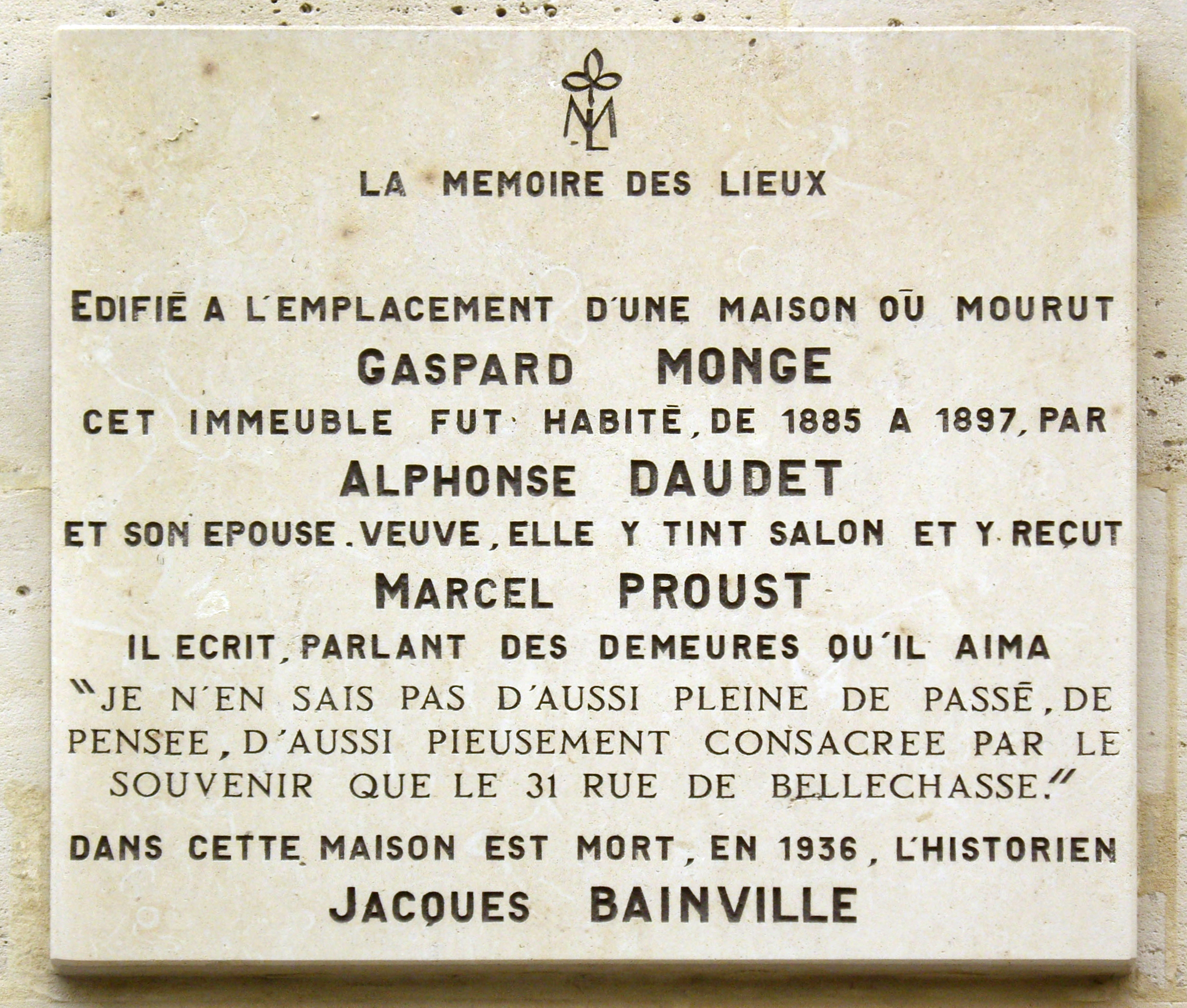
Plaque: 31, rue de Bellechasse
La mémoire des lieux
Edifié à l'emplacement d'une maison où mourut
Gaspard Monge
cet immeuble fut habité, de 1885 à 1897, par
Alphonse Daudet
et son épouse. Veuve, elle y tint salon et y reçut
Marcel Proust
Il écrit, parlant des demeures qu'il aima
"Je n'en sais pas d'aussi pleine de passé, de
pensée, d'aussi pieusement consacrée par le
souvenir que le 31 rue de Bellechasse."
Dans cette maison est mort, en 1936, l'historien
Jacques Bainville
Gaspard Monge died in a house formerly locayted here. Alphonse Daudet and his wife lived in the present building in 1885-1897. After his death she held a salon whereMarcel Proust used to come. He wrote, speaking of the houses he liked: 'I know none as filled of the past and of thought, or as piously consecrated by remembrance than the 31 rue de Bellechasse'.
The historian Jacques Bainville died in this house in 1936.
Plaque: 102, boulevard Haussmann
Marcel Proust
1871-1922
habita cet immeuble
de 1907 à 1919.
Marcel Proust
1871-1922
lived here
from 1907 to 1919.
Plaque: 96, rue La Fontaine
Ici naquit
Marcel Proust
le 10 juillet 1871
Marcel Proust was born here, 10 July 1871.
Plaque: 10, rue Dombasle
Walter Benjamin, 1892-1940, philosophe et écrivain allemand, traducteur de Proust et Baudelaire, a vécu dans cet immeuble de 1938 à 1940.
Walter Benjamin, 1892-1940, German philosopher and writer, who translated Proust and Baudelaire, lived here 1938-1940.

Wikipédia fr:Marcel Proust
Wikipedia En:Marcel Proust
Copyrights: Images hotlinked from Wikipedia Commons retain their licences. All other pictures are CC-BY-NC-SA, Serendiparis, 2001-2013
Pisarro, father of Impressionism, was born today in 1830

Camille Pissarro, né à Saint Thomas (Îles Vierges, alors possession danoise) le 10 juillet 1830 et mort à Paris le 13 novembre 1903, est l'un des pères de l'impressionnisme. Il a peint la vie rurale française, le travail des champs, mais aussi des scènes de Montmartre. Il eut entre autres pour élèves Paul Cézanne et Paul Gauguin. Pissarro, comme Gauguin, fréquentait assidument les peintres anarchistes de la Nouvelle-Athènes.

Camille Pissarro (10 July 1830 – 13 November 1903) was a Danish-French Impressionist and Neo-Impressionist painter born on the island of St Thomas (now in the US Virgin Islands, but then in the Danish West Indies). His importance resides in his contributions to both Impressionism and Post-Impressionism. Pissarro studied from great forerunners, including Gustave Courbet and Jean-Baptiste-Camille Corot. He later studied and worked alongside Georges Seurat and Paul Signac when he took on the Neo-Impressionist style at the age of 54.
Camille Pissarro
Camille Pissarro
Plaque: rue Saint Rustique
Cette maison, dite alors 'Aux billards en bois', et célèbre depuis 1850, fut jusqu'en 1900 le lieu de réunion de Diaz, Pisarro, Degas, Sisley, Cézanne, T.Lautrec, Renoir, Monet, E.Zola. Son jardin servit de modèle à Van Gogh pour son chef d'œuvre La Guinguette, qu'il fit ici en octobre 1866, exposé au Louvre.
This house, then called 'Aux billards en bois', which is famous since 1850, was until 1900 the meeting place for Diaz, Pisarro, Degas, Sisley, Cézanne, T.Lautrec, Renoir, Monet, E.Zola. Its garden was the subject of Van Gogh's materpiece La Guinguette, which can be seen in Le Louvre museum.

Wikipédia fr:Camille Pissarro
Wikipedia En:Camille Pissarro
Copyrights: Images hotlinked from Wikipedia Commons retain their licences. All other pictures are CC-BY-NC-SA, Serendiparis, 2001-2013

Wednesday, March 18, 2015

Jacques de Molay, last Grand Master of the Knights Templar, was burned today in 1314.

Jacques de Molay, né entre 1240 et 1250, et mort le 18 mars 1314 (ou le 11), brûlé sur sur un bûcher dressé sur l'Île de la Cité à Paris, fut le 23e et dernier maître de l'ordre du Temple. Son nom est un des plus connus parmi les Templiers (avec celui du fondateur de l'ordre, Hugues de Payns), bien que l'on ne dispose que de peu d'informations sur les deux premiers tiers de sa vie. Il avait été élu grand maître avant le 20 avril 1292. Il s’était distingué par sa valeur au combat en Terre sainte avant d’accéder à la tête de l’ordre, mais, une fois en France, il se montra piètre politique face à Philippe IV le Bel, Guillaume de Nogaret et Enguerrand de Marigny, et il ne put empêcher la chute de son ordre.
Jacques de Molay (c. 1243 – 18 March 1314) was the 23rd and last Grand Master of the Knights Templar. Little is known of his actual life and deeds except for his last years as Grand Master. King Philip IV of France, deeply in debt to the Templars, had De Molay and many other French Templars arrested in 1307 and tortured into making false confessions. When De Molay later retracted his confession, Philip had him burned upon a scaffold on an island in the River Seine in Paris, in March 1314.
Jacques de Molay
Jacques de Molay
Plaque: pont Neuf, square du Vert Galant
A cet endroit, Jacques de Molay, dernier Grand maître de l'Ordre du Temple, a été brûlé le 18 mars de 1314
in this place Jacques De Molay, last Grand Master of the Knights Templar, was burned March 18th, 1314.

Wikipédia fr:Jacques de Molay
Wikipedia En:Jacques de Molay
Copyrights: Images hotlinked from Wikipedia Commons retain their licences. All other pictures are CC-BY-NC-SA, Serendiparis, 2001-2013
Friday, March 13, 2015

Sylvia Beach, an American-born bookseller and publisher who lived most of her life in Paris, was born today in 1887

Sylvia Beach, née le 14 mars 1887 à Baltimore, Maryland et morte le 5 octobre 1962 à Paris, était une libraire et éditrice américaine.
 
Sylvia Beach arrive à Paris en 1916, et devient la compagne de la libraire Adrienne Monnier. En 1919, elle ouvre sa propre librairie « Shakespeare and Co » au 8 rue Dupuytren, laquelle déménagera en mai 1921 au 12 rue de l'Odéon. Sa librairie accueille alors les intellectuels américains et anglo-saxons de Paris (Man Ray, Ezra Pound, Ernest Hemingway), mais aussi français (Valery Larbaud, André Gide, Paul Valéry, Jacques Lacan).
 
En 1922, elle publie la version originale du roman de James Joyce, Ulysse, dont Adrienne Monnier publiera la première traduction française en 1929.
 

Sylvia Beach (March 14, 1887 – October 5, 1962), born Nancy Woodbridge Beach, was a American-born bookseller and publisher who lived most of her life in Paris, where she was one of the leading expatriate figures between World War I and II. She is known for her Paris bookstore, Shakespeare and Company, which published James Joyce's controversial book, Ulysses.
 
Sylvia Beach | Sylvia Beach, James Joyce and Adrienne Monnier at Shakespeare & Co. in Paris in c. 1920. Image courtesy of the Beinecke Rare Book & Manuscript Library, Yale University
Plaque: 10, rue de l'Odéon
En 1922,
dans cette maison,
Mlle Sylvia Beach publia
"Ulysses"
de James Joyce.
JJSSF
In 1922
in this house
Miss Sylvia Beach published
Ulysses
by James Joyce.
JJSSF

Wikipédia fr:Sylvia Beach
Wikipedia En:Sylvia Beach
Copyrights: Images hotlinked from Wikipedia Commons retain their licences. All other pictures are CC-BY-NC-SA, Serendiparis, 2001-2013