Showing posts with label Place:France. Show all posts

Friday, May 13, 2016

The Society of The Cincinnati was founded today in 1783 by George Washington

La Société des Cincinnati (Society of the Cincinnati) est la plus ancienne société patriotique américaine, fondée par George Washington le 13 mai 1783 et composée de ceux qui s'étaient distingués pendant la Guerre d'indépendance des États-Unis.
La section française a été fondée en janvier 1784 à Paris.


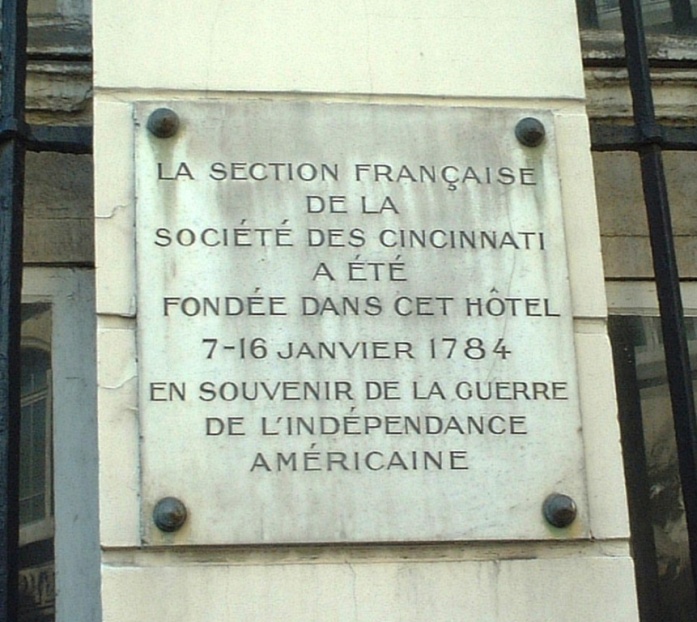
The Society of the Cincinnati was founded by George Washingtion to preserve the ideals and fellowship of the American Revolutionary War officers. Its French branch was founded in January 1784 in Paris, to which a plaque near the Latin Quarter bears testimony.

   
Société des Cincinnati
Plaque: 40, rue du Cherche Midi
La section francaise
de la
société des Cincinnati
a été
fondée dans cet hôtel
7-16 janvier 1784
en souvenir de la guerre
de l'indépendance
américaine

The French branch of the Society of the Cincinnati was founded in this mansion, 7-16 January 1784, in remembrance of the American Independance War  

Wikipédia fr:Société des Cincinnati
Wikipedia En:Society of the Cincinnati
Copyrights: Images hotlinked from Wikipedia Commons retain their licences. All other pictures are CC-BY-NC-SA, Serendiparis, 2001-2013

Saturday, April 16, 2016

Tristan Tzara, poet and founder of Data, was born today in 1986

Tristan Tzara, né le 16 avril 1896 à Moinesti, Roumanie et mort le 25 décembre 1963 à Paris, est un écrivain, poète et essayiste de langue roumaine et française; il est l'un des fondateurs du mouvement Dada dont il sera par la suite le chef de file.

Tristan Tzara, a Romanian and French avant-garde poet, essayist and performance artist, one of the founders and central figures of the anti-establishment Dada movement, was born in Romania in 1896, moved to Paris in 1911, where he spent most of his life. He died in Paris on Christmas day, 1963. His house in Montmartre was designed by Austrian architect Adolf Loos.     
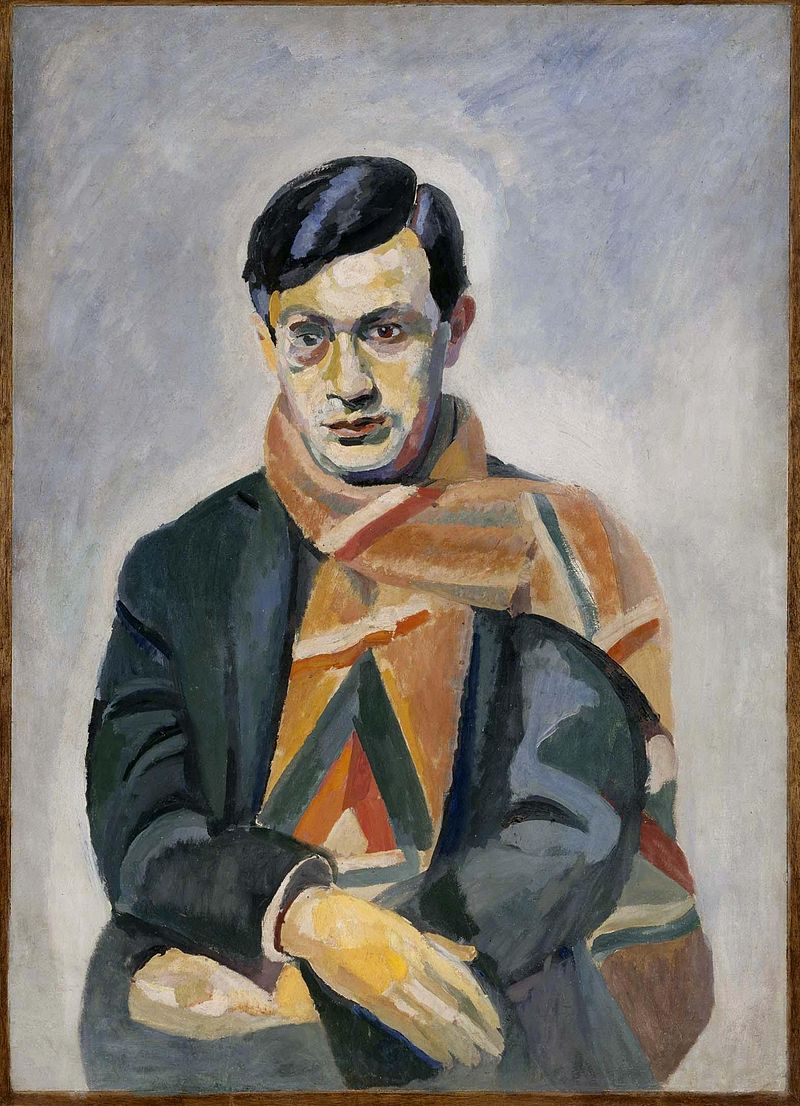
Tristan Tzara
Tristan Tzara
by Robert Delaunay
Plaque: 29, rue Campagne Première
Dans l'effervescence créatrice des années 1920 L'hôtel Istria accueillit entre autres artistes Francis Picabia, Marcel Duchamp, Moïse Kisling, peintres; Man Ray, photographe; Kiki de Montparnasse, modèle et égérie; Eric Satie, compositeur; Rainer-Maria Rilke, Tristan Tzara, Vladimir Maïakovski, poètes; et Louis Aragon qui y rejoignait Elsa Triolet.

"Ne s'éteint que ce qui brilla... Lorsque tu descendais de l'hôtel Istria Tout était différent rue Campagne Première, En mil neuf cent vingt neuf, vers l'heure de midi...", Louis Aragon (Il ne m'est Paris que d'Elsa).

Association La Mémoire des Lieux

In the roaring 1920s this hotel Istria hosted numerous artists including Francis Picabia, Marcel Duchamp, Moïse Kisling, painters; Man Ray, photographer; Kiki de Montparnasse, model and égérie; Eric Satie, composer; Rainer-Maria Rilke, Tristan Tzara, Vladimir Maïakovski, poets; and Louis Aragon who joined Elsa Triolet.

"Only what has been bright can fade away… When you used to come to hôtel Istria every thing looked different in street Campagne Première, in nineteen hundred and twenty nine, around noon time…", Louis Aragon (Il ne m'est Paris que d'Elsa).

The Memory of Places Society
Plaque: 13, avenue Junot
Maison construite en 1926 par
l'architecte autrichien
Adolf Loos
1870 - 1933
pour l'écrivain Tristan Tzara

House built in 1926 by Austrian architect Adolf Loos (1870-1933) on behalf of writer Tristan Tzara.

Wikipédia fr:Tristan Tzara
Wikipedia En:Tristan Tzara
Copyrights: Images hotlinked from Wikipedia Commons retain their licences. All other pictures are CC-BY-NC-SA, Serendiparis, 2001-2013

Wednesday, January 6, 2016

Khalil Gibran, Lebanese American writer, was born today in 1883

Gibran Khalil Gibran (جبران خليل جبران), poète et peintre libanais, est né le 6 janvier 1883 à Bcharré, Liban. En 1895, il émigre avec sa famille aux États-Unis, où il vivra la majeure partie de sa vie; il est mort le 10 avril 1931 à New York. En 1908-1910, Gibran étudier la peinture à Paris, où il fréquente, entre autres, l'atelier Colarossi. Publié en 1923 et composé de vingt-six textes poétiques, son recueil "Le Prophète" est devenu particulièrement populaire pendant les années 1960 dans le courant de la contre-culture et les mouvements New Age.
 

Kahlil Gibran (جبران خليل جبران)(January 6, 1883 – April 10, 1931), a Lebanese-American artist, poet, and writer, was born in the north of modern-day Lebanon, and immigrated with his family to the United States in 1895, where he studied art and began his literary career, writing in both English and Arabic. He studied painting in Paris in 1908-1910. He is chiefly known in the English-speaking world for his 1923 book The Prophet, an early example of inspirational fiction including a series of philosophical essays written in poetic English prose, which gained popularity in the 1960s counterculture.
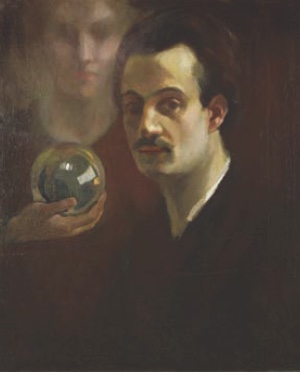
Khalil Gibran | selfportrait/autoportrait, c. 1911
Khalil Gibran | autoportrait, c. 1911
Plaque: 14, avenue du Maine
Ici
vécut
de 1908 à 1910
Gibran Khalil Gibran
1883-1931
peintre et poète
libano-americain.
Gibran Khalil Gibran
1883-1931
Lebanese American
painter and poet
lived
here
1908 - 1910.

Wikipédia fr:Khalil Gibran
Wikipedia En:Khalil Gibran
Copyrights: Images hotlinked from Wikipedia Commons retain their licences. All other pictures are CC-BY-NC-SA, Serendiparis, 2001-2013

Saturday, September 12, 2015

Elsa Triolet, Russian-French writer, was born today in 1896, in Moscow

Elsa Triolet,  née Elsa Kagan, est une femme de lettres d'origine russe née le 12 septembre 1896 à Moscou. Après avoir, à19 ans, connu Maiakovski, elle épouse un offier français en 1918 et le suit à son retour en France. Elle rencontre Louis Aragon en 1928; leur vie commune dure jusqu'au décès d'Elsa, le 16 juin 1970, dans leur propriété de Saint-Arnoult-en-Yvelines. C'est Elsa qui incite Aragon à adhérer au parti communiste, et ils participent ensemble à la Résistance pendant la seconde guerre mondiale. Elsa Triolet est, en 1944, la première femme a obtenir le prix Goncourt.

Elsa Triolet,  née Elsa Kagan, is a French writer of Russian origin. She was born 12 September 1896 in Moscou. She meets Mayakovski, when she is 19. A year later, she marries a French army officer, and follows him when he returns to France, before divorcing. She meets Louis Aragon in 1928; they live together until she dies, 16 June 1970, in their property near Paris. It is Elsa who incites Aragon to join the Communist parti. They take part in the French Resistance. In 1944, she is the first woman to be awarded the prix Goncourt, the most famous prize in French literature.
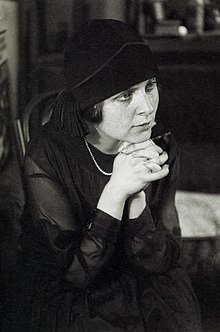
Elsa Triolet | 1925
Elsa Triolet | 1925
Plaque: 29, rue Campagne Première
Dans l'effervescence créatrice des années 1920 L'hôtel Istria accueillit entre autres artistes Francis Picabia, Marcel Duchamp, Moïse Kisling, peintres; Man Ray, photographe; Kiki de Montparnasse, modèle et égérie; Eric Satie, compositeur; Rainer-Maria Rilke, Tristan Tzara, Vladimir Maïakovski, poètes; et Louis Aragon qui y rejoignait Elsa Triolet.

"Ne s'éteint que ce qui brilla... Lorsque tu descendais de l'hôtel Istria Tout était différent rue Campagne Première, En mil neuf cent vingt neuf, vers l'heure de midi...", Louis Aragon (Il ne m'est Paris que d'Elsa).

Association La Mémoire des Lieux
In the roaring 1920s this hotel Istria hosted numerous artists including Francis Picabia, Marcel Duchamp, Moïse Kisling, painters; Man Ray, photographer; Kiki de Montparnasse, model and égérie; Eric Satie, composer; Rainer-Maria Rilke, Tristan Tzara, Vladimir Maïakovski, poets; and Louis Aragon who joined Elsa Triolet.

"Only what has been bright can fade away… When you used to come to hôtel Istria every thing looked different in street Campagne Première, in nineteen hundred and twenty nine, around noon time…", Louis Aragon (Il ne m'est Paris que d'Elsa).

The Memory of Places Society

Wikipédia fr:Elsa Triolet
Wikipedia En:Elsa Triolet
Copyrights: Images hotlinked from Wikipedia Commons retain their licences. All other pictures are CC-BY-NC-SA, Serendiparis, 2001-2013

Friday, July 10, 2015

Pisarro, father of Impressionism, was born today in 1830

Camille Pissarro, né à Saint Thomas (Îles Vierges, alors possession danoise) le 10 juillet 1830 et mort à Paris le 13 novembre 1903, est l'un des pères de l'impressionnisme. Il a peint la vie rurale française, le travail des champs, mais aussi des scènes de Montmartre. Il eut entre autres pour élèves Paul Cézanne et Paul Gauguin. Pissarro, comme Gauguin, fréquentait assidument les peintres anarchistes de la Nouvelle-Athènes.

Camille Pissarro (10 July 1830 – 13 November 1903) was a Danish-French Impressionist and Neo-Impressionist painter born on the island of St Thomas (now in the US Virgin Islands, but then in the Danish West Indies). His importance resides in his contributions to both Impressionism and Post-Impressionism. Pissarro studied from great forerunners, including Gustave Courbet and Jean-Baptiste-Camille Corot. He later studied and worked alongside Georges Seurat and Paul Signac when he took on the Neo-Impressionist style at the age of 54.
Camille Pissarro
Camille Pissarro
Plaque: rue Saint Rustique
Cette maison, dite alors 'Aux billards en bois', et célèbre depuis 1850, fut jusqu'en 1900 le lieu de réunion de Diaz, Pisarro, Degas, Sisley, Cézanne, T.Lautrec, Renoir, Monet, E.Zola. Son jardin servit de modèle à Van Gogh pour son chef d'œuvre La Guinguette, qu'il fit ici en octobre 1866, exposé au Louvre.
This house, then called 'Aux billards en bois', which is famous since 1850, was until 1900 the meeting place for Diaz, Pisarro, Degas, Sisley, Cézanne, T.Lautrec, Renoir, Monet, E.Zola. Its garden was the subject of Van Gogh's materpiece La Guinguette, which can be seen in Le Louvre museum.

Wikipédia fr:Camille Pissarro
Wikipedia En:Camille Pissarro
Copyrights: Images hotlinked from Wikipedia Commons retain their licences. All other pictures are CC-BY-NC-SA, Serendiparis, 2001-2013

Tuesday, August 27, 2013

Man Ray, American surrealist artist

Man Ray (Emmanuel Radnitzky), né le 27 août 1890, à Philadelphie, États-Unis, mort le 18 novembre 1976, à Paris, France, est un peintre, photographe et réalisateur de films, acteur du dadaïsme à New York, puis du surréalisme à Paris.
 
Man Ray a passé la plus grande part de sa vie à Paris, notamment autour de Montparnasse . Une plaque rappelle qu'il fréquentait, comme Picabia et Duchamp, l'hôtel Istria. Il est mort à Paris et y est enterré, au cimetière du Montparnasse.
[... Lire sur Wikipédia]


Man Ray (born Emmanuel Radnitzky, August 27, 1890 – November 18, 1976) was an American modernist artist who spent most of his career in Paris, France. He was a significant contributor to the Dada and Surrealist movements, although his ties to each were informal.
"One of the 25 most influential artists of the 20th century" (ArtNews magazine, 1999), Man Ray produced major works in a variety of media but considered himself a painter above all, although he is now best known for his avant-garde photography, in fashion and portrait.
[... More on Wikipedia]
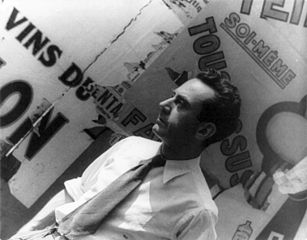
Man Ray | Portrait by Carl Van Vechten, Paris, 1934
Man Ray | Man Ray by Carl Van Vechten, Paris, 1934
Plaque: 29, rue Campagne Première
Dans l'effervescence créatrice des années 1920 L'hôtel Istria accueillit entre autres artistes Francis Picabia, Marcel Duchamp, Moïse Kisling, peintres; Man Ray, photographe; Kiki de Montparnasse, modèle et égérie; Eric Satie, compositeur; Rainer-Maria Rilke, Tristan Tzara, Vladimir Maïakovski, poètes; et Louis Aragon qui y rejoignait Elsa Triolet.

"Ne s'éteint que ce qui brilla... Lorsque tu descendais de l'hôtel Istria Tout était différent rue Campagne Première, En mil neuf cent vingt neuf, vers l'heure de midi...", Louis Aragon (Il ne m'est Paris que d'Elsa).

Association La Mémoire des Lieux
In the roaring 1920s this hotel Istria hosted numerous artists including Francis Picabia, Marcel Duchamp, Moïse Kisling, painters; Man Ray, photographer; Kiki de Montparnasse, model and égérie; Eric Satie, composer; Rainer-Maria Rilke, Tristan Tzara, Vladimir Maïakovski, poets; and Louis Aragon who joined Elsa Triolet.

"Only what has been bright can fade away… When you used to come to hôtel Istria every thing looked different in street Campagne Première, in nineteen hundred and twenty nine, around noon time…", Louis Aragon (Il ne m'est Paris que d'Elsa).

The Memory of Places Society

Wikipédia fr:Man Ray
Wikipedia En:Man Ray
Copyrights: Images hotlinked from Wikipedia Commons retain their licences. All other pictures are CC-BY-NC-SA, Serendiparis, 2001-2013

Monday, August 26, 2013

Lavoisier, "Father of Modern chemistry", was born in Paris on 26 August 1743

Antoine Laurent de Lavoisier, né le 26 août 1743 à Paris et mort le 8 mai 1794 guillotiné à Paris,chimiste, philosophe et économiste français, est "le père de la chimie moderne". Il a énoncé la première version de la loi de conservation de la matière, identifié et baptisé l'oxygène (1778), démis la théorie phlogistique, et participé à la réforme de la nomenclature chimique.
[... Lire sur Wikipédia]


Antoine Laurent Lavoisier, born August 26, 1743 in Paris, chemist, French philosopher and economist, is the "father of modern chemistry." He stated the first version of the law of conservation of matter, recognized and named oxygen (1778), dismissed the phlogiston theory, and participated in the reform of chemical nomenclature. Benjamin Franklin was familiar with Lavoisier, as they were both members of the "Benjamin Franklin inquiries" into Mesmer and animal magnetism. Lavoisier died under the guillotine in Paris, on May 8, 1794.  
[... More on Wikipedia]
Antoine Lavoisier | Farmacia a san Calimero, Milano
Plaque: 1, rue Bassompierre
Ici se trouvait
l'Hôtel de la Régie des poudres
où travailla et habita
Antoine-Laurent Lavoisier,
régisseur des Poudres et salpêtres,
qui y installa son laboratoire de chimie.
Here stood the
Hotel de la Régie des poudres
where
Antoine-Laurent Lavoisier,
régisseur des Poudres et Salpêtres,
lived and worked,
having installed here
his laboratory.

Wikipédia fr:Antoine Lavoisier
Wikipedia En:Antoine Lavoisier
Copyrights: Images hotlinked from Wikipedia Commons retain their licences. All other pictures are CC-BY-NC-SA, Serendiparis, 2001-2013

Thursday, August 15, 2013

Napoleon, French Emperor

Napoléon Bonaparte est né le 15 août 1769 à Ajaccio.
Une rue et pas moins de 8 plaques portent son nom dans Paris.
[... Lire sur Wikipédia]


Napoleon Bonaparte was born in Ajaccio (Corsica) on 15 August, 1769.
 
In Paris, no less than eight plaques mention Napoleon Bonaparte, commemorating the Louisiana Purchase, his marriage, and his coup on 18 Brumaire.
[... More on Wikipedia]
Napoléon Bonaparte | Bonaparte crossing the Alps, Jacques-Louis David, 1801
Plaque: rue Croix des Petits Champs
En ce lieu, à l'époque ministère du Trésor, le 18 avril 1803, a été signé l'acte de cession de la Louisiane par la France à la république des Etats-Unis d'Amérique. Les signataires étaient Barbé-Marbois, au nom du premier consul Bonaparte, et Livingston et Monroe, envoyés du président Jefferson. France-Louisiane, Franco-Américanie, le Souvenir napoléonien
on April 30, 1803, in this building, which was then the Treasury Department, the treaty was signed by which France transferred property of Louisiana to the Republic of the United States of America. The signatories were Barbe Marbois, on behalf of the First Consul Bonaparte, and Livingston and Monroe, envoys of President Jefferson.
France-Louisiane, Franco-Americania, the Napoleonic Remembrance
Plaque: rue La Fayette
Ici le 1er juillet 1810, le prince de Schwartzenberg, ambassadeur d'Autriche, donnait un bal en l'honneur du mariage de Napoléon Ier avec Marie-Louise de Habsbourg-Lorraine. Au cours de la soirée se déclarait un violent incendie à la suite duquel l'empereur décida par décret du 18 septembre 1811 la réorganisation du corps des pompiers en un bataillon militaire. La brigade des sapeurs-pompiers de Paris en est aujourd'hui l'héritière
On 1st July, 1810, the Prince of Schwarzenberg, the Austrian ambassador, gave a ball here in honor of the marriage of Napoleon to Marie-Louise of Habsburg-Lorraine. During the evening a violent fire broke out. As a consequence, the Emperor decided by decree dated 18 September 1811 that the Fire Brigade would henceforth be organized as a military battalion.
Today's Paris firefighter brigade are their heirs.
Plaque: 3, rue d'Antin
Mairie de l'ancien IIe arrondissement où fut célébré le 9 mars 1796 le mariage du général Bonaparte et de Joséphine de Beauharnais.
City hall of the former 2nd arrondissement, where on 9 March, 1796, General Bonaparte married Josephine de Beauharnais.
Plaque: 60, rue de la Victoire
A cet emplacement s'élevait l'allée conduisant à l'hôtel où demeura le général Bonaparte après son mariage avec Joséphine de Beauharnais le 19 ventôse an IV (9 mars 1796). Le pavillon d'habitation et le jardin y attenant occupaient la place correspondant aux immeubles situés entre les numéros 47 et 51 de la rue de Châteaudun. C'est de la rue de la Victoire, ci-devant Chantereine, que Napoléon Bonaparte partit pour les Tuileries, le matin du 18 brumaire an VIII (9 novembre 1799).
At this location was a driveway leading to the hotel where General Bonaparte remained after his marriage with Josephine de Beauharnais 19 Ventôse IV (9 March 1796). The dwelling house and garden adjoining it occupied the site corresponding to buildings located between numbers 47 and 51 rue de Châteaudun.
From this Rue de la Victoire, formerly Chantereine Napoléon Bonaparte set off to the Tuileries, on the morning of 18 Brumaire Year VIII (9 November 1799).
Plaque: 10, rue de la Grange Batelière
Edifié sous Louis XV
hôtel de Mr de Nolivos, capitaine
aux gardes françaises sous Louis XVI.
Résidence du marquis de Lillers,
chambellan de l'empereur Napoléon Ier.
Cercle romantique de Mr Tattet
qui réunissait Vigny, Musset
et Victor Hugo.
Built during the reign of Louis XV.
Hotel of Monsieur de Nolivos, captain of the Gardes-Française regiment, under Louis XVI.
Home of marquis de Lilliers, chamberlain of Emperor Napoleon.
M.Tattet's romantic circle where Vigny, Musset and Victor Hugo met.
Plaque: 98, rue du Bac
Ici était le cabaret des deux Auges où logea en 1804 le Chouan Georges Cadoudal, 1771-1804, alors qu'il préparait son complot contre Bonaparte
Here was the cabaret where the chouan leader Cadoudal lived in 1804 when he was preparing his plot against Bonaparte
Plaque: 11, rue de la Montagne Sainte Geneviève, 75005. Ecole polytechnique
Le XIV frimaire an XIII (3 décembre 1804), à la distribution des Aigles au Champ de Mars, l'empereur Napoléon a remis à l'élève Arago, premier sergent des élèves, le premier drapeau de l'Ecole polytechnique, le général Lacuée étant gouverneur de l'Ecole.
On XIV Frimaire XIII (3 December 1804), during the distribution of the Eagles at the Champ de Mars, Emperor Napoleon gave the student Arago, first sergeant of students, the first flag of the Polytechnic School, General Lacuee being the school governor.
Plaque: 50, rue de Varenne
En cet hôtel, qui fut le siège du ministère des Relations extérieures, le 3 janvier 1798 au cours d'une réception organisée par Talleyrand alors ministre, Madame de Staël a rencontré pour la première fois Napoléon Bonaparte.
In this hotel, which was the headquarters of the Ministry of Foreign Affairs, during a reception hosted by then Minister Talleyrand on 3 January, 1798, Madame de Stael has met for the first time Napoleon Bonaparte.

Wikipédia fr:Napoléon Ier
Wikipedia En:Napoleon
Copyrights: Images hotlinked from Wikipedia Commons retain their licences. All other pictures are CC-BY-NC-SA, Serendiparis, 2001-2013

Wednesday, January 16, 2013

The Society of the Cincinnati

La Société des Cincinnati (Society of the Cincinnati) est la plus ancienne société patriotique américaine, fondée par George Washington le 13 mai 1783 et composée de ceux qui s'étaient distingués pendant la Guerre d'indépendance des États-Unis.
 
La section française a été fondée en janvier 1784 à Paris.

The Society of the Cincinnati is an historical, hereditary lineage organization with branches in the United States and France, founded in 1783 to preserve the ideals and fellowship of the American Revolutionary War officers. The city of Cincinnati, Ohio, then a small village, was named after the Society. Now in its third century, the Society promotes public interest in the American Revolution through its library and museum collections, exhibitions, programs, publications, and other activities.
Société des Cincinnati
Plaque: 40, rue du Cherche Midi
La section francaise
de la
société des Cincinnati
a été
fondée dans cet hôtel
7-16 janvier 1784
en souvenir de la guerre
de l'indépendance
américaine
The French branch of the Society of the Cincinnati was founded in this mansion, 7-16 January 1784, in remembrance of the American Independance War  

Wikipédia fr:Société des Cincinnati
Wikipedia En:Society of the Cincinnati
Copyrights: Images hotlinked from Wikipedia Commons retain their licences. All other pictures are CC-BY-NC-SA, Serendiparis, 2001-2013

Thursday, January 3, 2013

Maurice Jaubert, film music composer

Maurice Jaubert est un compositeur français né à Nice le 3 janvier 1900, mort le 19 juin 1940 au front, à l'hôpital de Baccarat. Maurice Jaubert est particilièrement connu pour ses nombreuses partitions pour le cinéma, Zéro de conduite et L'Atalante de Jean Vigo, Quatorze Juillet de René Clair, Un carnet de bal et La Fin du jour de Julien Duvivier, Drôle de drame, Hôtel du Nord, Le Quai des brumes et Le jour se lève de Marcel Carné.

Maurice Jaubert (born Nice 3 January 1900 - wounded in combat at Azerailles near Baccarat, where he died 19 June 1940) was a French composer of incidental music for stage and film music, famous for his collaborations with the masters of poetic realism Jean Vigo, René Clair, Julien Duvivier and Marcel Carné. He also had a long collaboration with Jean Giraudoux.
 
From 1931-5 he was music director of the Pathé-Nathan studios, where he conducted not only his own scores but those of Arthur Honegger and Darius Milhaud. He makes a cameo appearance as a conductor in Kurt Bernhardt's La Nuit de décembre (1939). As a journalist he championed many composers, including Kurt Weill.
 
In Vigo's Zéro de conduite he played recorded sounds backwards to accompany a slow motion sequence, anticipating a favorite technique of musique concrète.
 
French film director François Truffaut used Jaubert's music in his films in the late 1970s.
Maurice Jaubert
Maurice Jaubert
Plaque: 98, rue du Cherche Midi
Maurice Jaubert
compositeur
habita cette maison
de 1931 à 1939
Mort pour la France
le 19 juin 1940
Maurice Jaubert, composer; lived here from 1931 to 1939. Mort pour la France, 19 June 1940.

Wikipédia fr:Maurice Jaubert
Wikipedia En:Maurice Jaubert
Copyrights: Images hotlinked from Wikipedia Commons retain their licences. All other pictures are CC-BY-NC-SA, Serendiparis, 2001-2013

Saturday, December 22, 2012

Hyacinthe Vincent, promoter of thyphoid vaccine

Hyacinthe Jean Vincent, né à Bordeaux le 22 décembre 1862 et mort à Paris le 23 novembre 1950, est un médecin français, connu principalement pour ses travaux sur la fièvre typhoïde et la gangrène gazeuse.
 
Médecin général inspecteur de l'armée, affecté à l'École militaire du dey d'Alger, Vincent y découvre le bacille Fusiformis fusiformis qui est à l'origine de l'angine ulcéro-membraneuse, généralement unilatérale, appelée «angine de Vincent».
 
Professeur agrégé au Val-de-Grâce, titulaire de la chaire d'épidémiologie et au Collège de France,
 
En 1912, il vaccine avec succès le contingent français d'Afrique du Nord contre la typhoïde grâce à un vaccin mis au point en 1896 par Almroth Wright en Angleterre et en 1909 par lui-même et André Chantemesse en France. Lors de la Première Guerre mondiale, une loi du 28 mars 1914 impose la  vaccinination contre la typhoïde et les paratyphoïdes A et B (vaccination T.A.B) et sauve l'armée française en supprimant presque totalement les cas de fièvre typhoïde. Les maréchaux Joffre et Foch lui rendent hommage.
 
On lui doit aussi la découverte du vaccin contre la gangrène gazeuse.
 
Membre de l'Académie de médecine, il est élu membre de l'Académie des sciences en 1922.

Jean Hyacinthe Vincent (22 December 1862 – 23 November 1950) was a French physician, associate professor at Val-de-Grâce, medical inspector general with the French Army, chair of epidemiology at Collège de France.
 
Vincent is credited with the discovery of the organisms that cause a 'trench mouth', an acute infection of the oral soft tissues, including the tonsils and pharynx, now called Vincent's angina or Vincent's gingivitis in honor of his discovery.
 
He is also remembered for his work with vaccines, and his successful inoculations of the French Army against typhoid fever and paratyphoid fever, types A and B. He started these vaccinations in 1910, and they were continued during World War I. Marshals Joseph Joffre (1852–1931) and Ferdinand Foch (1851–1929) paid homage to Vincent and his medical work that saved countless lives.
Hyacinthe Vincent
Hyacinthe Vincent
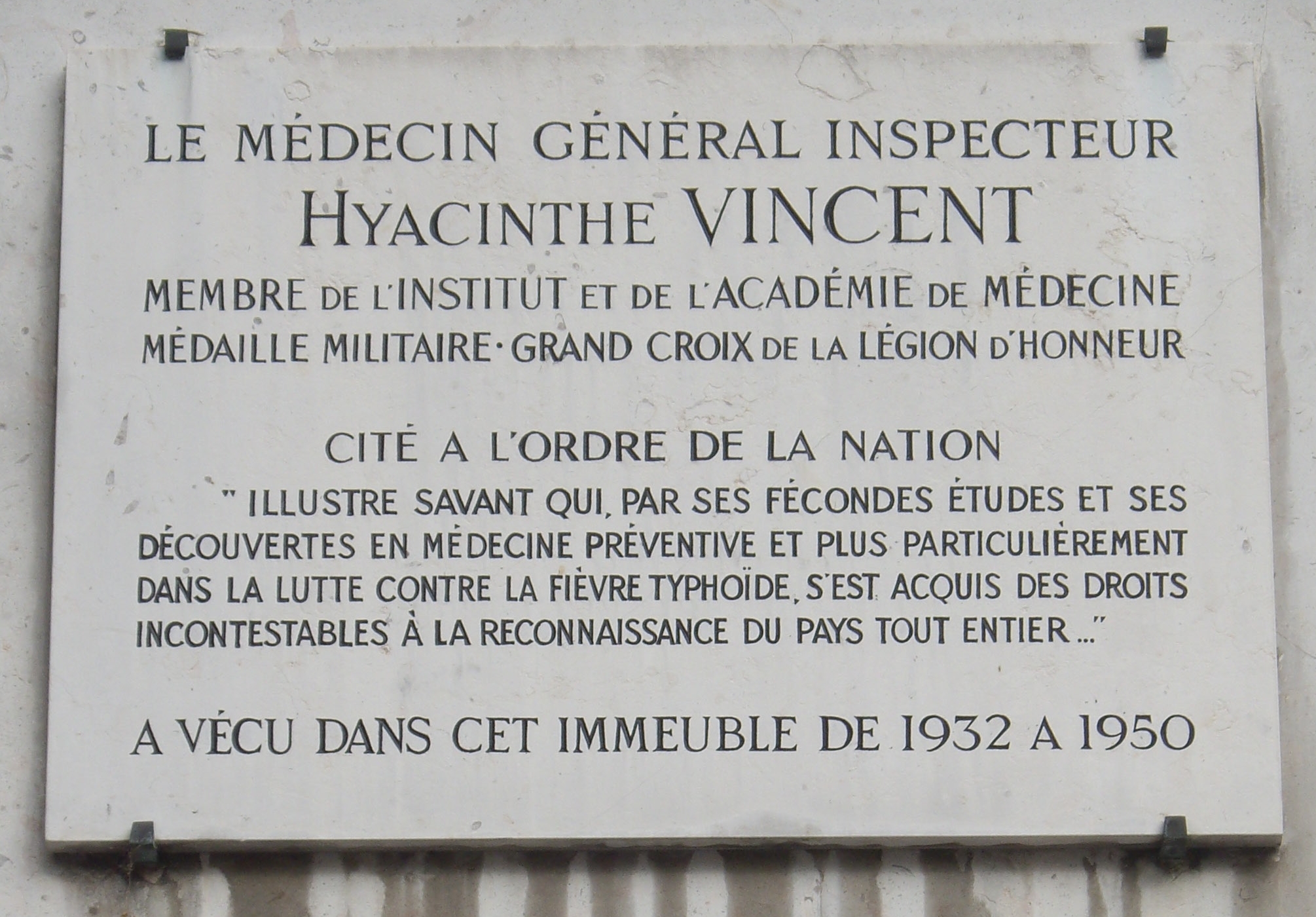
Plaque: 7, avenue Bosquet
Le médecin général inspecteur Hyacinthe Vincent,
membre de l'institut et de l'académie de médecine
médaille militaire,  grand croix de la légion d'honneur, cité à l'ordre de la nation, illustre savant qui par ses fécondes études et ses
découvertes en médecine préventive et plus particulièrement dans la lutte contre la fièvre typhoïde s'est acquis des droits incontestables à la reconnaissance du pays tout entier, a vécu dans cet immeuble de 1932 à 1950.
Hyacinthe Vincent,
medical inspector general with the French Army,
member of the Institut de France and Academy of Medicine,
Medaille militaire,
Grand cross of the Legion of Honor,
Recognized by the Nation,
Famous scientist whose studies and discoveries in preventative medicine, especially against typhoid fever, gained him indisputable rights for the gratitude of the whole nation,
lived here from 1932 to 1950.
 

Wikipédia fr:Hyacinthe Vincent
Wikipedia En:Jean Hyacinthe Vincent
Copyrights: Images hotlinked from Wikipedia Commons retain their licences. All other pictures are CC-BY-NC-SA, Serendiparis, 2001-2012

Saturday, October 13, 2012

André Chantemesse, developper of the antityphoid inoculation

André Chantemesse, né le 13 octobre 1851 au Puy-en-Velay et mort à Paris le 25 février 1919, est le médecin et biologiste français, qui a mis au point, avec Fernand Widal, un vaccin contre la fièvre typhoïde. Ayant démontré que l'on peut vacciner préventivement de petits animaux en leur injectant des doses de bacilles tués par chauffage. il voit cette méthode appliquée à l'homme en Allemagne et en Angleterre dès 1896.

André Chantemesse, born 13 Octobre 1851, is the French  biologist who, in collaboration with Georges-Fernand Widal, developed an experimental antityphoid inoculation in 1888. His method was used in the United Kingdom and Germany as soon as 1896.  
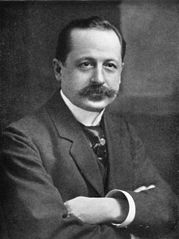
André Chantemesse, c. 1900 - Source: Wikimedia Commons
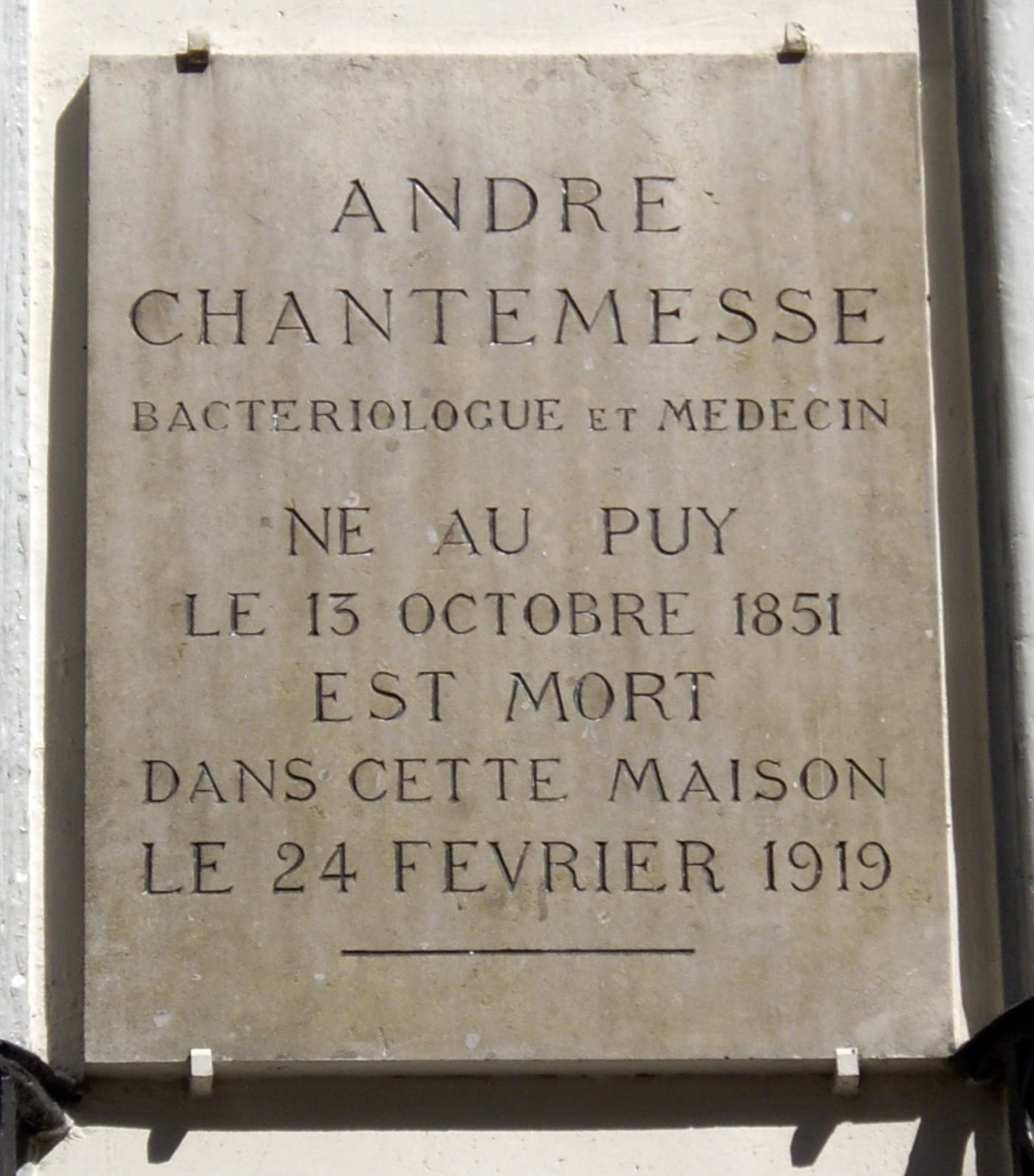
Plaque: 30, rue Boissy d'Anglas
André
Chantemesse,
bactériologue et médecin,
né au Puy
le 13 octobre 1851,
est mort
dans cette maison
le 24 février 1919
André
Chantemesse,
bacteriologist and MD,
born in Le Puy
13 October 1851,
died here
24 February 1919

Wikipédia fr:André Chantemesse
Wikipedia En:
Copyrights: Images hotlinked from Wikipedia Commons retain their licences. All other pictures are CC-BY-NC-SA, Serendiparis, 2001-2012

Saturday, August 11, 2012

Panait Istrati

Panaït Istrati, écrivain roumain d'expression roumaine et française parfois surnommé "le Gorki des Balkans", est né à Braila le 11 août 1884. Il est mort à Bucarest le 16 avril 1935. Une plaque commorative rappelle qu'Istrati habita Paris entre 1922 et 1930 et y rédigea une partie de son œuvre.

Panait Istrati (10 August, 1884 – 18 April 1935) was a Romanian writer of French and Romanian expression, nicknamed The Maxim Gorky of the Balkans. He lived in Paris for 8 years, during which he authored a large part of his work: see plaque.
Panait Istrati
Panait Istrati
Plaque: 24, rue du Colisée
Entre 1922 et 1930, dans cette maison,
l'écrivain roumain
Panait Istrati
(1884-1935)
a écrit ses œuvres majeures de réputation
mondiale (Kyra Kyralina, Codine, Mikhail,
Oncle Anghel,  Les Haïdouks, Nerantsoula)
Between 1922 and 1930, in this house,
the Romanian writer
 Panait Istrati
(1884-1935)
wrote his main books,
renowned worldwide (Kyra Kyralina, Codine, Mikhail,
Oncle Anghel,  Les Haïdouks, Nerantsoula)

Wikipédia fr:Panaït Istrati
Wikipedia En:Panait Istrati
Copyrights: Images hotlinked from Wikipedia Commons retain their licences. All other pictures are CC-BY-NC-SA, Serendiparis, 2001-2012

Wednesday, July 25, 2012

25 August 1909: Blériot crosses the Channel

Le 25 juillet 1909, Louis Blériot effectue la première traversée aérienne entre la France et le Royaume Uni. Une plaque marque la maison où il est mort à Paris.

On 25 July 1909, Louis Blériot made the first flight across the English Channel in a heavier than air aircraft, winning the prize of £1,000 offered by the Daily Mail newspaper.
Louis Blériot
Louis Blériot
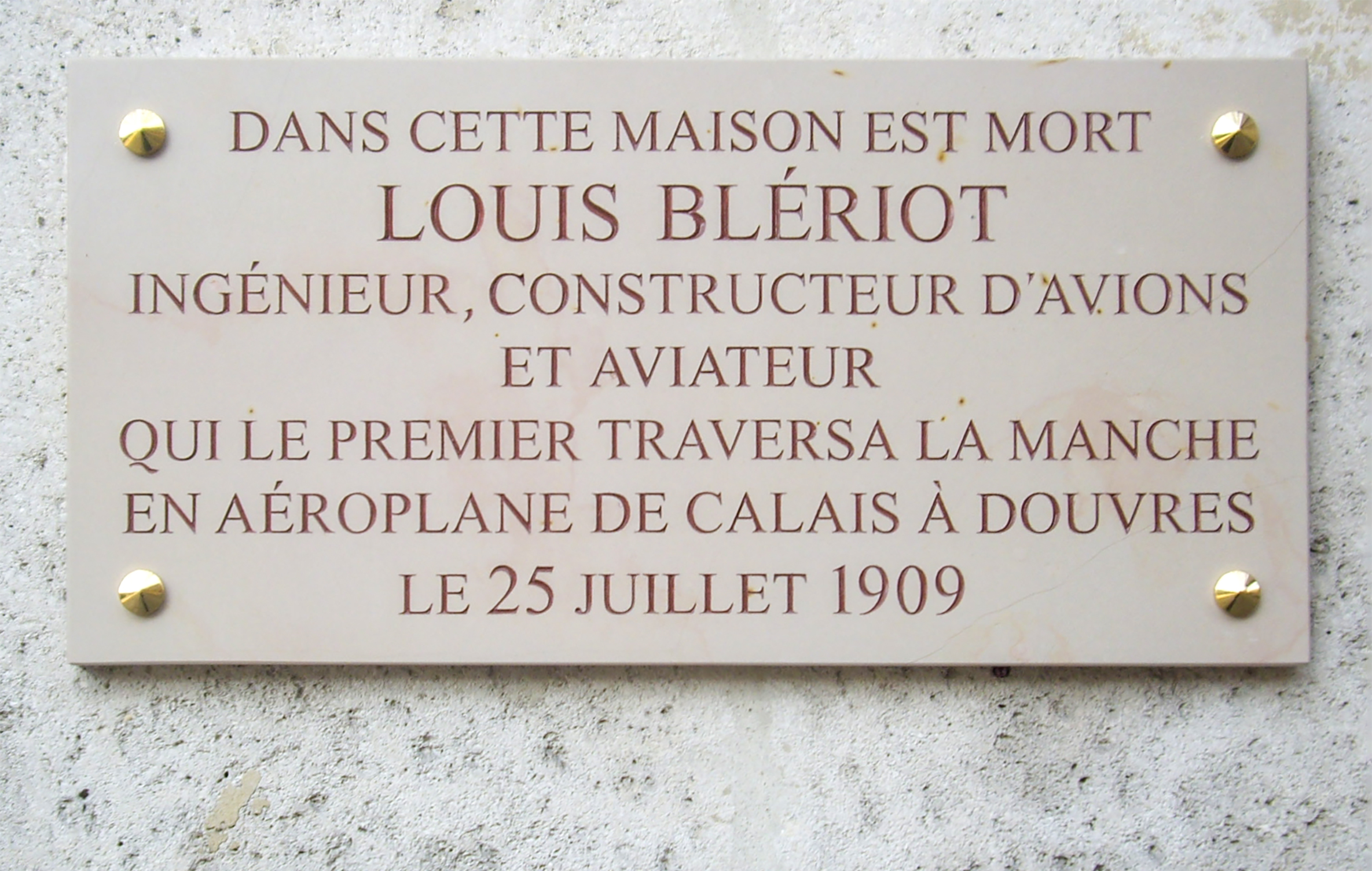
Plaque: 288, boulevard Saint Germain
Dans cette maison est mort Louis Blériot, ingénieur, constructeur d'avions et aviateur, qui le premier traversa la Manche en aéroplane de Calais à Douvres le 25 juillet 1909

Wikipédia fr:Louis Blériot
Wikipedia En:Louis Blériot
Copyrights: Images hotlinked from Wikipedia Commons retain their licences. All other pictures are CC-BY-NC-SA, Serendiparis, 2001-2012

Monday, July 2, 2012

Gen Paul

le peintre Eugène Paul, dit Gen Paul, est né le 2 juillet 1895 dans une maison de la rue Lepic (Paris XVIIIe), peinte par Van Gogh. Souvent qualifié d'« expressionniste » et de « peintre de Montmartre », ce qui est assez réducteur, cet auto didacte était aussi gouachiste, dessinateur, graveur et lithographe. Il reçut la Légon d'Honneur en 1934. Il a notamment voyagé aux Eatts-Unis où il a peint des jazzmen et musiciens classiques, un sujet qu'il affectionnait. Il a été un ami de Louis-Ferdinand Céline. Il est mort le 30 avril 1975 à Paris.

Born as Eugène Paul in a house in Montmartre on the Rue Lepic painted by Van Gogh, Gen Paul (July 2, 1895 – April 30, 1975), was a French painter and engraver. Due to the dynamism and motion inherent in his paintings, some consider Gen Paul to be the first action painter, a precursor to the abstract expressionists of the 1950s. In 1934, he was awarded the Legion of Honor. In addition to painting scenes from his native Montmartre, including that of his friend, composer Darius Milhaud, Gen Paul travelled to the United States where he painted jazz and classical musicians, a subject with which he had much interest.
Gen-Paul | Portrait sur le site annuart.com
Gen-Paul | Portrait sur le site annuart.com.
Plaque: imp Girardon
Eugène Paul dit Gen-Paul
artiste peintre
et graveur français
a vécu et créé
dans cette maison
de 1917 à 1975

Wikipédia fr:Eugène Paul
Wikipedia En:Gen Paul
Copyrights: Images hotlinked from Wikipedia Commons retain their licences. All other pictures are CC-BY-NC-SA, Serendiparis, 2001-2012

Wednesday, June 27, 2012

Louis XII, roi de France

Louis XII, né le 27 juin 1462 au château de Blois, mort le 1er janvier 1515 à Paris, est roi de France du 7 avril 1498 à sa mort. Son règne est marqué par les guerres d'Italie, qui s'achèvent avec la défaite de Novare en 1513 et, au plan intérieur, la réforme de la justice et des impôts. Il fut surnommé le « Père du peuple » par les états généraux de 1506. Son image fut cultivée après sa mort comme symbole d'une monarchie modérée.
 
Trois plaques le mentionnent à Paris. A l'entrée du site Richelieu de la BnF, une plaque fait référence au rôle de Louis XII dans le développement des collections de la Bibliothèque royale. Rue Saint André des Arts, une autre plaque rappelle que le jeune Louis habita l'hôtel de Navarre.

Louis XII, king of France, was born on 27 June 1462. Sometimes called "the Father of the People", he was the sole monarch from the Valois-Orléans branch of the House of Valois. He reigned from 1498 and pursued a very active foreign policy. His reign ended whith his life, on the first day of year 1515.
 
Three plaques mention Louis XII. One emphasizes his role in expanding the collections of the royal library, which is the origin of the present Bibliothèque nationale de France (BnF). Another show where the young dauphin lived until his 22nd year.
Louis XII
Plaque: 58, rue de Richelieu
XIVe siècle. Charles V, fondateur de la bibliothèque, réunit plus de neuf cents volumes dans une tour du Louvre. Le catalogue en est dressé par Gilles Mallet.

XVe siècle. Sous le règne de Charles VII et de Louis XII, la bibliothèque établie dans les châteux d'Amboise et de Blois et comprenant les collections des ducs d'Orléans, s'accroît de livres imprimés et de manuscrits recueillis en Italie.

XVI siècle. François Ier fait rechercher, acheter et copier des manuscrits orientaux grecs et latins. Il installe somptueusement la bibliothèque dans le château de Fontainebleau et la met à la disposition des savants. La bibliothèque est transférée à Paris vers l'année MDLXX.
XIVth century. Charles V, founder of the Library gathers more than 900 volumes into a tower in the Louvre castle. The catalogue is compiled by Gilles Mallet.
 
XVth C. Under kings Charles VII and Louis XII, the Library, which sits in the Amboise and Blois castles, and comprises books collected by the dukes of Orléans, is expanded with printed books ans manuscripts gathered in Italy.
 
XVIth C. François I orders that Eastern, Greek and Latin manuscripts be sought, bought and copied. He installs the Library in grandiose settings in the Fontainebleau castle and lets resaerchers use his collections. The Library is transferred to Paris in year MDLXX.
Plaque: 49, rue Saint André des Arts
Sur cet emplacement
s'élevait l'Hôtel de Navarre.
Ce fut ensuite
le séjour d'Orléans.
––
Louis XII
avant son avènement au trône
l'habita jusqu'en 1484
Here stood the Hotel de Navarre, later known as séjour d'Orléans. Louis XII, before becoming king, lived here until 1484.
Plaque: 4, rue Rollin
Du règne de Loys XIIe, cest premiere pierre a este posee par Jehan Hubert, fils de Jehan Hubert, Me apothicaire à Paris, le XXIX mars 1623.
During the reign of Louis the XIIth, this first stone was set by Jehan Hubert, son of Master Jehan Hubert, apothecary in Paris, on XXIX March, 1623.

Wikipédia fr:Louis XII de France
Wikipedia En:Louis XII of France
Copyrights: Images hotlinked from Wikipedia Commons retain their licences. All other pictures are CC-BY-NC-SA, Serendiparis, 2001-2012

Thursday, June 14, 2012

René Char

René Char est le 14 juin 1907, à L'Isle-sur-la-Sorgue. Poète et résistant français, décédé le 19 février 1988 à Paris, il habita, de 1954 à 1978, rue de Chanaleilles, non loin de là où Gide avait vécu, rue Vaneau.


René Char, a French poet, was born in L'Isle-sur-le-Sorgue, France, on 14 June 1907. Between 1954 and 1978 he lived in rue de Chanaleilles, Paris, when he was in Paris; this was a few hundred yards from where André Gide had lived, in rue Vaneau. He died in Paris, 19 February 1988.
René Char
Plaque: 4, rue de Chanaleilles
Dans cette maison a vécu de 1954 à 1978 René Char, 1907-1988.  "Un poète doit laisser des traces de son passage, non des preuves. Seules les traces font rêver." - La Parole en forêt.
René Char, 1907-1988, lived in this house from 1954 to 1978. 'A poet must leave traces of his being here, not proofs. Only traces fire the imagination.' Words in a forest.


Wikipédia fr:René Char
Wikipedia En:René Char
Copyrights: Images hotlinked from Wikipedia Commons retain their licences. All other pictures are CC-BY-NC-SA, Serendiparis, 2001-2012

Friday, May 18, 2012

Ruder Josip Boškovic

Ruder Josip Boškovic (18 mai 1711, Raguse - 13 février 1787, Milan), est un jésuite dalmate qui était mathématicien, physicien, astronome, poète et philosophe. Il était citoyen de République de Raguse (aujourd'hui Dubrovnik, Croatie). Astronome, fondateur de l'atomisme moderne, natif de Dubrovnik, croate de naissance, français d'adoption, il a travaillé à Paris de 1775 à 1777.

Ruder Josip Boškovic (18 May 1711 – 13 February 1787) was a physicist, astronomer, mathematician, philosopher, diplomat, poet, theologian, Jesuit, and a polymath from the city of Dubrovnik in the Republic of Ragusa (today Croatia), who studied and lived in Italy and France where he also published many of his works.

He is famous for his atomic theory and made many important contributions to astronomy, including the first geometric procedure for determining the equator of a rotating planet from three observations of a surface feature and for computing the orbit of a planet from three observations of its position. In 1753 he also discovered the absence of atmosphere on the Moon.
Roger Joseph Boscovich
Plaque: 2, rue de Seine
Dans cette maison a vécu et travaillé
de 1775 à 1777
Roger Joseph Boscovich
philosophe, mathématicien et astronome
fondateur de l'atomisme moderne
natif de Dubrovnik
croate de naissance, français d'adoption

U ovoj je kuci zivio i radio
od 1775 do 1777
Rugjer Josip Boscovic
In this house
Roger Joseph Boscovich
lived and worked
1775 – 1777
philosopher, mathamatician and astronomer
creator of the modern atom theory
born in Dubrovnik
Croatian by birth, French by choice

U ovoj je kuci zivio i radio
od 1775 do 1777
Rugjer Josip Boscovic


Wikipédia fr:Ruder Josip Boškovic
Wikipedia En:Ruder Boškovic
Copyrights: Images hotlinked from Wikipedia Commons retain their licences. All other pictures are CC-BY-NC-SA, Serendiparis, 2001-2012

Thursday, May 17, 2012

Erik Satie

Alfred Eric Leslie Satie, dit Erik Satie, né à Honfleur le 17 mai 1866 et mort à Paris le 1er juillet 1925, est un compositeur et pianiste français. (Wikipédia)
Deux plaques commémorent sa vie et son travail à Paris.

Éric Alfred Leslie Satie (17 May 1866 – Paris, 1 July 1925; signed his name Erik Satie after 1884) was a French composer and pianist. Satie was a colourful figure in the early 20th century Parisian avant-garde. His work was a precursor to later artistic movements such as minimalism, repetitive music, and the Theatre of the Absurd.

An eccentric, Satie was introduced as a "gymnopedist" in 1887, shortly before writing his most famous compositions, the Gymnopédies. Later, he also referred to himself as a "phonometrician" (meaning "someone who measures sounds") preferring this designation to that of a "musician", after having been called "a clumsy but subtle technician" in a book on contemporary French composers published in 1911.[2]

In addition to his body of music, Satie also left a remarkable set of writings, having contributed work for a range of publications, from the dadaist 391 to the American culture chronicle Vanity Fair. Although in later life he prided himself on always publishing his work under his own name, in the late nineteenth century he appears to have used pseudonyms such as Virginie Lebeau and François de Paule in some of his published writings.
(Wikipedia)
Erik Satie
Plaque: 6, rue Cortot
Erik Satie
compositeur de musique
a vécu dans cette maison
de 1890 à 1898
Erik Satie,
composer,
lived in this house
1890-1898
Plaque: 29, rue Campagne Première
Dans l'effervescence créatrice des années 1920 L'hôtel Istria accueillit entre autres artistes Francis Picabia, Marcel Duchamp, Moïse Kisling, peintres; Man Ray, photographe; Kiki de Montparnasse, modèle et égérie; Eric Satie, compositeur; Rainer-Maria Rilke, Tristan Tzara, Vladimir Maïakovski, poètes; et Louis Aragon qui y rejoignait Elsa Triolet.

"Ne s'éteint que ce qui brilla... Lorsque tu descendais de l'hôtel Istria Tout était différent rue Campagne Première, En mil neuf cent vingt neuf, vers l'heure de midi...", Louis Aragon (Il ne m'est Paris que d'Elsa).

Association La Mémoire des Lieux
In the roaring 1920s this hotel Istria hosted numerous artists including Francis Picabia, Marcel Duchamp, Moïse Kisling, painters; Man Ray, photographer; Kiki de Montparnasse, model and égérie; Eric Satie, composer; Rainer-Maria Rilke, Tristan Tzara, Vladimir Maïakovski, poets; and Louis Aragon who joined Elsa Triolet.

"Only what has been bright can fade away… When you used to come to hôtel Istria every thing looked different in street Campagne Première, in nineteen hundred and twenty nine, around noon time…", Louis Aragon (Il ne m'est Paris que d'Elsa).

The Memory of Places Society


Wikipédia fr:Erik Satie
Wikipedia En:Erik Satie
Copyrights: Images hotlinked from Wikipedia Commons retain their licences. All other pictures are CC-BY-NC-SA, Serendiparis, 2001-2012

Tuesday, May 15, 2012

Arletty

Arletty, pseudonyme de Léonie Bathiat, née le 15 mai 1898 à Courbevoie, est une actrice française, l'une des plus populaires des années 1930-1940 tant sur la scène qu'à l'écran. Ses deux rôles les plus mémorables au cinéma sont sans doute ceux de Raymonde dans Hôtel du Nord (Marcel Carné, 1938) et Garance dans Les Enfants du paradis(Marcel Carné, 1945). De 1962 à sa mort le 23 juillet 1992, elle vécut au 14, rue de Rémusat, Paris 16e, où une plaque commémorative rappelle au passant que pour elle "Tout dans la vie est une question de savoir rire (…). C'est partager le rire que de s'aimer".

Arletty, one of the most popular French actresses on film and stage in the 1930-1940 period, was born on 15 May, 1898 in Courbevoie, near Paris. Her major roles on film include Raymonde in Hôtel du Nord(Marcel Carné, 1938) and Garance in Les Enfants du Paradis (Children of Paradise, Marcel Carné, 1945). She lived for 30 years in her appartment in 14 rue de Rémusat, Paris 16th arrondissement, where a plaque reminds us that for her "The whole life is about being able to laugh… To love is to laugh together"
Arletty
Plaque: 14, rue Rémusat
Arletty (Léonie Bathiat), 1898-1992, habita cet immeuble de 1969 à sa mort.
Au théâtre, elle fut l'interprète de Sacha Guitry, de Colette et de Jean Cocteau. Au cinéma, celle de Henri Jeanson et de Jacques Prévert, dans des films réalisés par Marcel Carné ( Hôtel du nord, Le jour se lève, Les Visiteurs du soir, Les Enfants du paradis ).
Devenue aveugle, cette comédienne exceptionnelle vécut ses dernières années dans la sérénité.
"Tout dans la vie est une question de savoir rire (…). C'est partager le rire que de s'aimer" — Arletty.
Arletty (Léonie Bathiat), 1898-1992, lived here from 1962 to her death.
On the stage she acted in plays by Sacha Guitry, Colette and Jean Cocteau. On film she worked with Henri Jeanson and Jacques Prévert, under Marcel Carné's direction ( Hôtel du nord, Le jour se lève, The Devil's Envoys, Children of Paradise ).
Although she had become blind this exceptional actress spent her last years in calm and serenity.
"Life is all about being able to laugh… To love is to share one's laughs" — Arletty.


Wikipédia fr:Arletty
Wikipedia En:Arletty
Copyrights: Images hotlinked from Wikipedia Commons or other sites retain their licenses. All other pictures are CC-BY-NC-SA, Serendiparis, 2001-2012